
Uveitis Treatment in Delhi
Uveitis is inflammation of the uvea — the middle, blood-vessel-rich layer of your eye — and if left untreated, it can lead to glaucoma, cataract, retinal damage, or permanent vision loss. At Save Sight Centre, Dr. Rajeev Jain, a renowned Uveitis specialist with fellowship training across three continents, provides thorough diagnosis and personalised treatment to control inflammation and protect your sight.
🔎 Quick Answer: Uveitis Treatment
Uveitis is inflammation of the uvea — the eye's middle layer, which includes the iris, ciliary body, and choroid — and can be caused by infections, autoimmune disease, trauma, or unknown (idiopathic) reasons. At Save Sight Centre, a NABH and ISO accredited hospital opposite Adarsh Nagar Metro Station, Dr. Rajeev Jain, a renowned Uveitis specialist with over 25 years of experience and fellowship training from LV Prasad Eye Institute, Sydney Eye Hospital, and Royal Adelaide Hospital, provides complete uveitis care — from steroid eye drops and oral/injectable medication to immunosuppressive therapy and biologics for chronic or severe cases. Left untreated, uveitis can cause glaucoma, cataract, retinal damage, or permanent vision loss, so prompt evaluation for eye pain, redness, or blurred vision matters.
Uveitis can come on suddenly with pain and redness, or slowly with little pain but gradual blurring of vision — both patterns need prompt evaluation.
Dr. Rajeev Jain, renowned Uveitis specialist, has 25+ years of experience and authored the Uveitis chapter for the Wills Eye Manual on Vitreoretina Diseases.
Treatment ranges from steroid eye drops to oral medication, injections, immunosuppressive drugs, and biologics — matched to the cause and severity.
Left untreated, uveitis can lead to glaucoma, cataract, retinal damage, and in rare cases, permanent vision loss.
Uveitis is often linked to autoimmune conditions like rheumatoid arthritis, sarcoidosis, and ankylosing spondylitis, or infections like tuberculosis and herpes.
Regular follow-up is essential even after symptoms improve, since uveitis has a tendency to recur in some patients.
How does Uveitis Treatment work?
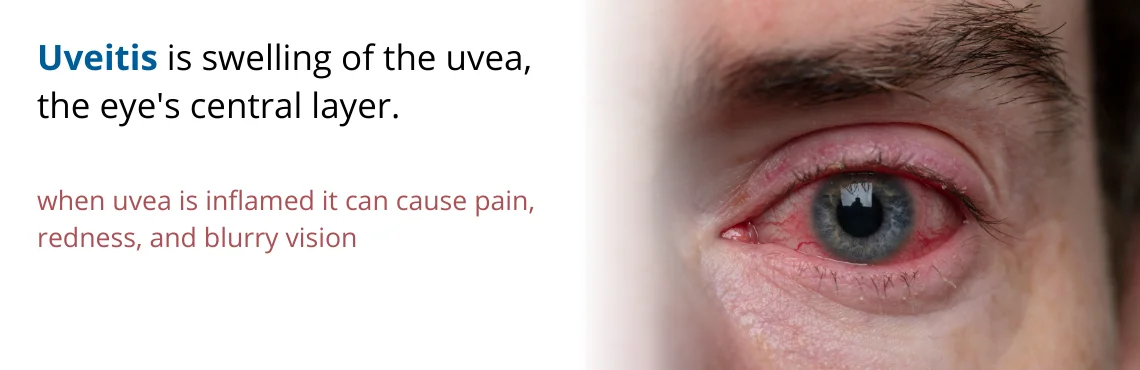
Uveitis is inflammation of the uvea — the middle layer of the eye, made up of the iris, ciliary body, and choroid. The uvea contains many of the blood vessels that nourish the eye, so when it becomes inflamed, the effects can spread to affect the cornea, retina, sclera, and other vital eye structures.
Because the uvea sits so close to critical structures, uveitis can be more sight-threatening than more common, superficial eye inflammations like conjunctivitis. It's important to understand there's usually no active infection in uveitis itself — it's an immune-mediated reaction, though it can be triggered by an infection elsewhere. Uveitis may occur as a single, isolated episode, or in some patients it becomes chronic and recurrent, which is why a thorough workup to identify a possible underlying cause matters.
Uveitis is often linked to broader health conditions, so an ophthalmologist evaluating uveitis will frequently look beyond the eye itself, sometimes involving other specialists like rheumatologists or pulmonologists to get a complete picture of your health.
Symptoms of Uveitis Treatment
What Vision Problems Can Uveitis Treatment Correct?
Affects the front of the eye, particularly the iris. Typically causes redness, light sensitivity, and blurry vision, and can come on suddenly with pain.
Targets the middle area of the eye, commonly causing floaters and mild discomfort rather than significant pain or redness.
Involves the back of the eye and may not show obvious symptoms early on, but can lead to vision problems and floaters — regular monitoring is important.
Inflammation affects the iris, ciliary body, and choroid together, combining symptoms from the other types and often requiring more intensive treatment.
Inflammation of both the iris and ciliary body together — a specific pattern of anterior uveitis causing redness, light sensitivity, and blurry vision.
Risk Factors for Uveitis Treatment
Treatment Options for Uveitis Treatment
Most cases of uveitis are effectively controlled with anti-inflammatory medication, escalated in intensity based on how deep and severe the inflammation is.
- Topical Steroid Eye Drops: The main first-line treatment for anterior uveitis affecting the front of the eye, often combined with pupil-dilating drops to relax the eye muscles and reduce pain.
- Oral or Injectable Steroids: For deeper inflammation, oral medication or injections around the eye (such as sub-Tenon's depot steroid injections) may be needed to control disease that drops alone can't reach.
- Immunosuppressive Medications: For autoimmune-driven uveitis or cases needing long-term steroid-sparing treatment, drugs like Methotrexate or Azathioprine help regulate the immune response under close monitoring.
Reserved for chronic, severe, or vision-threatening cases, or to manage complications that have already developed.
- Biologic Therapy: Targets specific molecules that drive inflammation, offering an advanced option with often better side-effect profiles for patients who don't respond adequately to conventional immunosuppressive drugs.
- Managing Complications: Complications like glaucoma or cataract that develop from uveitis are actively treated in parallel — through medication or surgery as needed — to protect overall visual outcome.
- Surgery for Retinal Damage: If uveitis leads to retinal complications, surgical procedures can address the resulting damage and help restore clarity of vision.
What Tests Are Done Before Uveitis Treatment?
Slit-Lamp Examination
A detailed microscopic examination of the front and inside of the eye, allowing your specialist to directly see signs of inflammation, often before any signs appear elsewhere in the body.
Tonometry
Measures eye pressure, since uveitis can contribute to secondary glaucoma — a key complication to monitor closely throughout treatment.
Dilated Fundus Examination
Your specialist examines the retina and back of the eye through a dilated pupil to check for posterior involvement, retinal damage, or complications.
Optical Coherence Tomography (OCT)
Provides a detailed cross-sectional view of the retina, helping detect associated swelling (macular edema) or other structural changes.
Blood Tests & Mantoux (TB) Test
Blood work and specific tests like the Mantoux test help identify underlying infectious or autoimmune causes, since uveitis is frequently linked to disease elsewhere in the body.
Imaging & Specialist Referral
X-rays, CT scans, or referral to a rheumatologist, pulmonologist, or immunologist may be needed when uveitis appears linked to a systemic condition requiring coordinated care.
How Is Uveitis Treatment Performed Step by Step?
Medical Management — Most cases of uveitis are effectively controlled with anti-inflammatory medication, escalated in intensity based on how deep and severe the inflammation is.
Topical Steroid Eye Drops
The main first-line treatment for anterior uveitis affecting the front of the eye, often combined with pupil-dilating drops to relax the eye muscles and reduce pain.
Oral or Injectable Steroids
For deeper inflammation, oral medication or injections around the eye (such as sub-Tenon's depot steroid injections) may be needed to control disease that drops alone can't reach.
Immunosuppressive Medications
For autoimmune-driven uveitis or cases needing long-term steroid-sparing treatment, drugs like Methotrexate or Azathioprine help regulate the immune response under close monitoring.
Advanced & Surgical Treatment — Reserved for chronic, severe, or vision-threatening cases, or to manage complications that have already developed.
Biologic Therapy
Targets specific molecules that drive inflammation, offering an advanced option with often better side-effect profiles for patients who don't respond adequately to conventional immunosuppressive drugs.
Managing Complications
Complications like glaucoma or cataract that develop from uveitis are actively treated in parallel — through medication or surgery as needed — to protect overall visual outcome.
Surgery for Retinal Damage
If uveitis leads to retinal complications, surgical procedures can address the resulting damage and help restore clarity of vision.
What Should You Avoid After Uveitis Treatment?
Stopping Medication Early
Never stop steroid or immunosuppressive medication abruptly without medical guidance — sudden stopping can trigger a flare-up.
Missing Follow-Up Visits
Uveitis can recur even after symptoms resolve. Regular follow-up catches recurrence and complications early.
Ignoring New Symptoms
Any new eye pain, redness, or vision change during treatment should be reported promptly rather than waiting for your next scheduled visit.
Skipping Blood Test Monitoring
Immunosuppressive drugs require regular blood tests to monitor for side effects — don't skip these even if you feel well.
Self-Medicating
Avoid using leftover steroid drops or someone else's prescription — uveitis treatment must be tailored to your specific diagnosis and cause.
Uveitis vs Conjunctivitis: How Do You Tell a Serious Red Eye from a Minor One?
Not every red eye is uveitis — conjunctivitis (commonly called pink eye) is far more common and much less serious. Knowing the difference helps you decide how urgently to seek care.
| Feature | Uveitis Treatment | Conjunctivitis |
|---|---|---|
| Layer Affected | Uvea (iris, ciliary body, choroid) | Conjunctiva (surface membrane) |
| Pain Level | Often significant, deep eye pain | Mild irritation or itching |
| Vision Impact | Can cause real blurring | Usually minimal impact |
| Light Sensitivity | Common and often pronounced | Uncommon |
| Urgency | Needs prompt specialist evaluation | Usually manageable, less urgent |
Layer Affected
Pain Level
Vision Impact
Light Sensitivity
Urgency
What Are the Risks and Side Effects of Uveitis Treatment?
Secondary Glaucoma
Ongoing inflammation and steroid treatment can both raise eye pressure, leading to secondary glaucoma that needs its own monitoring and treatment.
Cataract Formation
Chronic inflammation and long-term steroid use can accelerate cataract development, sometimes requiring surgery once inflammation is controlled.
Retinal Damage & Macular Edema
Inflammation reaching the back of the eye can damage the retina or cause macular edema, both of which threaten central vision if untreated.
Scarring & Structural Damage
Prolonged inflammation can scar structures inside the eye, permanently affecting how the eye functions even after the active inflammation resolves.
Permanent Vision Loss
In severe or repeatedly untreated cases, uveitis can lead to permanent, significant vision loss — which is why early detection and diligent treatment are so strongly emphasised.
How Much Does Uveitis Treatment Cost in Delhi?
Uveitis treatment cost varies significantly based on the cause, severity, and type of treatment required — from simple eye drops to injections or surgery for complications. Here's a transparent overview:
| Uveitis Treatment | Cost |
|---|---|
| Consultation & Diagnostic Workup | As applicable |
| Topical Steroid Eye Drops | On assessment |
| Oral / Injectable Steroids | On assessment |
| Immunosuppressive / Biologic Therapy | On assessment |
| Surgery for Complications (Glaucoma/Cataract/Retina) | On assessment |
How Much Does Uveitis Treatment Cost in Delhi?
Doctors for Uveitis Treatment
Dr. Rajeev Jain
Dr. Rajeev Jain is a renowned Uveitis specialist in Delhi and the principal Vitreoretinal and Uveitis surgeon at Save Sight Centre, with 25+ years of experience diagnosing and managing both simple and complex uveitis cases, including those linked to autoimmune and systemic disease.
Frequently Asked Questions About Uveitis Treatment
Ready to Book Your Uveitis Treatment Consultation?
Book your consultation at Save Sight Centre, Delhi. Our expert team will help you understand your condition, recommend the right treatment and guide you through every step.