

 +91-7873-222-000
 WhatsApp

 Book Appointment

Vitrectomy for Retina Repair: Procedure, Recovery & Alternatives
The retina is a thin layer at the back of your eye that works like the film in a camera — it catches light and sends the picture to your brain. When something goes wrong inside the eye, like bleeding, scarring, or the retina pulling away from its normal spot, vision can worsen quickly. Vitrectomy is one of the most effective surgeries available today to fix these problems and protect sight. The idea of eye surgery sounds daunting, but it feels a lot less worrying once you understand exactly how it works.

Quick Answer
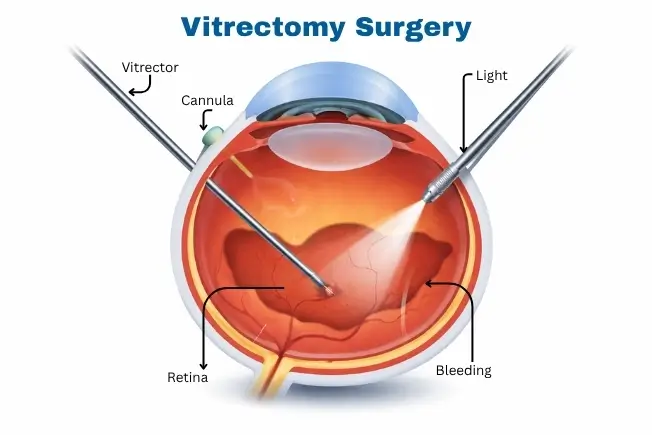
Vitrectomy is a surgery where a retina specialist removes the vitreous — the clear, jelly-like gel filling the middle of the eye — to gain access to the retina and repair problems like retinal detachment, diabetic eye disease, macular holes, or vitreous hemorrhage. The eye is then refilled with saline, a gas bubble, or silicone oil. It's a same-day, stitch-free procedure typically taking one to three hours, with a single-surgery success rate of roughly 85-90% for retinal detachment. Depending on the condition, alternatives like scleral buckle or pneumatic retinopexy may also be options, so your surgeon will recommend the approach best suited to your specific eye.
Key Takeaways
- Vitrectomy removes the vitreous gel to give the surgeon direct access to repair the retina — it's often the only treatment that truly works for serious retina problems.
- It treats retinal detachment, advanced diabetic eye disease, macular hole/pucker, and vitreous hemorrhage.
- Scleral buckle and pneumatic retinopexy are alternative (or complementary) procedures for retinal detachment, each with different trade-offs.
- If a gas bubble is used to fill the eye, air travel and high-altitude trips must be avoided until it fully dissolves — a genuine safety rule, not just a precaution.
- Single-surgery success rates for retinal detachment repair run around 85-90%, with a second surgery achieving reattachment in most remaining cases.
- Full visual recovery can take several weeks to a few months, and many patients develop a cataract within a year or two, which is separately and easily treatable.
Figures reflect general clinical research and can vary based on the condition being treated and individual healing.
What Is Vitrectomy?
Vitrectomy is a small, careful surgery where the doctor removes the vitreous — the clear, jelly-like fluid filling the middle of the eye. Once this gel is removed, the surgeon can reach the retina at the back of the eye and repair whatever has gone wrong. After the repair, the space is refilled with a saltwater solution, a gas bubble, or silicone oil, depending on what your eye needs. This surgery is performed by a retina specialist using very thin tools, some finer than a strand of hair. Modern vitrectomy is gentle, usually needs no stitches, and is typically done with just numbing drops or an injection around the eye.
Why Does Vitrectomy Matter for Retina Repair?
The retina is delicate, and if it's damaged, vision loss can become permanent if not treated quickly. No eye drop or tablet can reach deep inside the eye to fix these problems. Vitrectomy gives the surgeon a clear, direct path to the back of the eye so repairs can actually be made. For many retina problems, this isn't simply one option among several — it's often the only treatment that genuinely works.
What Conditions Does Vitrectomy Treat?
Retinal Detachment
Occurs when the retina lifts away from the back of the eye, which can lead to permanent vision loss if untreated. Vitrectomy helps reposition the retina and secure it back in place.
Diabetic Eye Disease
In advanced diabetic retinopathy, blood or scar tissue can pull on the retina and distort vision. Vitrectomy removes this tissue and helps prevent further damage.
Macular Hole and Macular Pucker
These conditions affect the central part of the retina, leading to blurred or distorted vision. The procedure repairs the macula to improve visual clarity.
Vitreous Hemorrhage
Heavy bleeding inside the eye can block vision and prevent proper examination of the retina. Vitrectomy clears the blood and restores visibility. See our guide to retinal hemorrhage.
Doctors also use this surgery for heavy bleeding inside the eye, serious eye infections, injuries with something lodged inside the eye, and complications following other eye surgeries.
Is Vitrectomy the Only Surgery for Retinal Detachment?
No — depending on the type, location, and complexity of the detachment, your surgeon may recommend a different approach, or occasionally a combination:
Scleral Buckle: An entirely external procedure where a small silicone band is placed around the outside of the eyeball to gently indent the eye wall, relieving the pulling (traction) that's causing the retina to detach. Because it never enters the eye, it carries no risk of cataract formation, and has a success rate similarly in the 85-90% range for suitable cases.
Pneumatic Retinopexy: A less invasive, in-office option for select cases. A small gas bubble is injected into the eye, and with specific head positioning, it presses the detached portion of the retina back into place, usually paired with laser or freezing treatment to seal the tear. It suits detachments in the upper part of the retina and generally has a somewhat lower single-treatment success rate (roughly 75-85%) than vitrectomy or scleral buckle, but it avoids full surgery altogether when appropriate.
Vitrectomy vs Scleral Buckle vs Pneumatic Retinopexy
| Feature | Vitrectomy | Scleral Buckle | Pneumatic Retinopexy |
|---|---|---|---|
| Approach | Inside the eye | Outside the eye | In-office gas injection |
| Cataract risk | Yes, over time | No | No |
| Success rate (single op) | ~85-90% | ~85-90% | ~75-85% |
| Best suited for | Complex, larger, or posterior detachments | Simpler detachments, especially in younger patients | Small detachments in upper retina |
| Setting | Operating room | Operating room | Often in-office |
Your surgeon selects the approach based on the specific location, size, and cause of your retinal problem — this table is a general guide, not a substitute for individual evaluation.
How Does the Vitrectomy Procedure Work?
Vitrectomy is a day-care surgery, so you can usually go home the same day. First, the eye is numbed so you won't feel pain. The surgeon then makes three tiny cuts in the white part of the eye — small enough that they typically heal on their own without stitches. A cutting tool removes the vitreous gel through these tiny openings, while a small light illuminates the inside of the eye and a fluid line keeps the eye's shape steady throughout. Once the gel is removed, the surgeon addresses the actual problem — repositioning the retina, removing scar tissue, or closing a hole. Finally, the eye is filled with saline, a gas bubble, or silicone oil. The whole process typically takes one to three hours.
What Fills the Eye After Vitrectomy?
Saline solution
A simple saltwater solution, used when no additional internal pressure (tamponade) is needed to hold the retina in place during healing.
SF6 gas (sulfur hexafluoride)
A shorter-acting gas bubble, typically dissolving on its own within 2-3 weeks — used when the retina needs a shorter period of support.
C3F8 gas (perfluoropropane)
A longer-acting gas bubble, typically lasting 6-8 weeks, used for more complex repairs needing extended support while the retina heals securely.
Silicone oil
Used for the most complex or high-risk cases, providing long-term support. Unlike gas, it doesn't dissolve on its own and needs a separate, smaller procedure to remove it later.
Critical Safety Warning: Air Travel After a Gas Bubble
If your eye has been filled with a gas bubble, you must not fly or travel to high-altitude areas until your doctor confirms the bubble has fully dissolved. This isn't just a precaution — it's a genuine safety rule:
- Cabin pressure changes during a flight cause the gas bubble to expand rapidly inside the eye
- This can spike eye pressure to dangerous levels within a short time
- Severely elevated pressure can cause permanent, irreversible vision loss
Always tell your surgeon about any planned travel before your surgery, and carry written confirmation of your surgery and gas type if you must travel for any reason during the affected period.
What Are the Benefits of Vitrectomy?
Restores lost vision
For many patients, vitrectomy brings back vision that was blocked for weeks or months. People with heavy internal bleeding often notice significant improvement once the blood is cleared, making reading, driving, and recognising faces possible again.
Stops further damage
Some retina problems worsen rapidly if left untreated. Vitrectomy addresses the root cause — whether a detached retina, scar tissue, or a macular hole — and acting early generally means better long-term results.
Faster healing with modern tools
Very small, typically stitch-free incisions mean less pain, quicker healing, and a faster return to normal life compared to older surgical techniques.
What Is Recovery Like After Vitrectomy?
What was used to fill the eye during surgery affects how recovery unfolds. If a gas bubble was used, your doctor may ask you to keep your head in a specific position — often face-down — for several days, which helps the bubble press gently against the part of the retina that was repaired. Special face-down support pillows or chairs can make this period more manageable. Some redness, mild discomfort, and blurry vision are normal for the first few weeks. Your doctor will prescribe eye drops to prevent infection and reduce swelling. Most people return to light daily activities within one to two weeks, though full vision recovery can take several weeks to a few months.
What Are the Possible Risks?
Like any surgery, vitrectomy carries some risks — most are rare and manageable when the surgery is done by an experienced retina specialist.
Infection and bleeding
Although rare, an internal eye infection is a serious risk after any eye surgery. Mild bleeding can also occur during or after vitrectomy. Following your prescribed drops and keeping the eye clean greatly lowers these risks.
Cataract formation
Many patients, especially those above 50, develop a cataract within a year or two after vitrectomy, as the eye's natural lens gradually clouds. This is easily treated later with safe, routine cataract surgery.
Increased eye pressure or retinal tears
Some patients experience a rise in eye pressure after surgery, controllable with drops. In rare cases, new retinal tears can form during healing. Regular follow-up visits help your doctor catch and treat these early.
How Successful Is Retinal Detachment Surgery?
Vitrectomy and scleral buckle surgery both achieve a single-operation success rate in the region of 85-90% for reattaching the retina, with pneumatic retinopexy running somewhat lower, around 75-85%, depending on how carefully cases are selected for it. When a first surgery doesn't fully succeed, a second procedure very often completes the reattachment, bringing the overall long-term success rate close to universal for most patients. How much of your original vision returns depends heavily on whether the central macula was affected and how long the detachment was present before treatment — which is exactly why prompt evaluation after symptoms like sudden floaters or a shadow in your vision matters so much.
Who Performs Vitrectomy at Save Sight Centre?
At Save Sight Centre, vitrectomy procedures are led by Dr. Rajeev Jain, one of Delhi's most trusted retina specialists with over 15 years of surgical experience. An MBBS from Maulana Azad Medical College and MS in Ophthalmology from Guru Nanak Eye Centre, he has completed advanced vitreoretinal fellowships at LV Prasad Eye Institute (Hyderabad), Sydney Eye Hospital, and Royal Adelaide Hospital, and served as Clinical Lecturer at the University of Adelaide in 2007.
His expertise covers the full range of retinal conditions treated by vitrectomy, including diabetic retinopathy, retinal detachment, macular holes, epiretinal membranes, and age-related macular degeneration. This depth of training ensures every patient receives precise, world-class care backed by globally recognised surgical standards.
Dr. Rajeev JainDirector · Retina, Cataract, LASIK & Uvea Specialist
"Patients are often relieved to learn there isn't just one path to fixing a detached retina — vitrectomy, scleral buckle, and pneumatic retinopexy each have their place, and the right choice depends entirely on your specific eye. What I always stress, regardless of which technique we use, is that timing matters more than almost anything else: the sooner a detachment is treated, the better the visual outcome tends to be."
Frequently Asked Questions About Vitrectomy
No. The eye is fully numbed before surgery, so you will not feel pain. After surgery, you may feel mild soreness or a gritty feeling for a few days, which goes away with the medicine your doctor gives you.
Vision stays blurry for a few weeks at first. If a gas bubble is used, things will look hazy until the bubble goes away on its own, which takes two to eight weeks depending on the type of gas. Complete recovery of vision can take up to three months.
Many people do need a change in their glasses after surgery, especially if a cataract forms later. Your doctor will check your vision once the eye has fully healed before giving you a new prescription.
Yes. Occasionally, a second surgery is needed, for example, to remove silicone oil or to treat a problem that has come back. Repeat surgery is safe when done by a skilled retina specialist.
Most people with desk jobs can go back to work in one to two weeks if healing is going well. Those with physical jobs or jobs that need sharp vision may require three to four weeks or more. Your surgeon will guide you based on how your eye is healing.
Vitrectomy works from inside the eye, removing the vitreous gel to directly access and repair the retina. A scleral buckle works entirely from outside the eye — a small silicone band is placed around the eyeball to gently indent the wall and relieve the pulling that's causing the detachment. Because it doesn't enter the eye, a scleral buckle avoids any risk of cataract formation, though it isn't suitable for every type of retinal problem.
No — this is a genuine safety rule, not just a precaution. Air travel, and even travel to high-altitude areas, must be avoided until your doctor confirms the gas bubble has fully dissolved. Cabin pressure changes cause the gas to expand rapidly inside the eye, which can spike eye pressure dangerously and risk permanent vision loss. Always tell your surgeon about any planned travel before your surgery.
The two most common gases are SF6 (sulfur hexafluoride), which typically lasts around 2-3 weeks, and C3F8 (perfluoropropane), which lasts longer, typically 6-8 weeks. Your surgeon chooses the gas based on how much time the retina needs to heal securely in place.
Pneumatic retinopexy is a less invasive, in-office alternative for select retinal detachments — a small gas bubble is injected into the eye, and with specific head positioning, it presses the detached retina back into place, usually combined with laser or freezing treatment to seal the tear. It suits detachments in the upper portion of the retina and has a somewhat lower single-treatment success rate than vitrectomy, but avoids full surgery altogether when appropriate.
Vitrectomy and scleral buckle surgery both have a single-operation success rate in the region of 85-90% for reattaching the retina, with pneumatic retinopexy somewhat lower at around 75-85% depending on case selection. When a first surgery doesn't fully succeed, a second procedure very often achieves reattachment, bringing the overall long-term success rate close to universal in most cases.
Need Retina Surgery or a Second Opinion?
Get expert vitreoretinal care from Dr. Rajeev Jain at Save Sight Centre, Adarsh Nagar, North Delhi. NABH & ISO accredited · 15+ years · 1,70,000+ patients treated.
Disclaimer: The information on this site should not be considered medical advice. Please consult a doctor for determining the best procedure as well as the most appropriate lens for your eyes. Results may vary from person to person and we do not guarantee similar results for everyone.