

 +91-7873-222-000
 WhatsApp

 Book Appointment
Digital Eye Strain Specialists
Evidence-based care for digital eye strain, dry eyes, and screen-related headaches — diagnosed properly, then treated with a plan built around how you actually use screens.
🔎 Quick Answer: Computer Vision Syndrome
The most effective computer vision syndrome treatment combines four elements: a comprehensive eye exam to rule out an uncorrected refractive error, lubricating eye drops or other dry-eye care, an ergonomic screen setup paired with the 20-20-20 rule, and — where needed — a computer-specific eyeglass prescription. At Save Sight Centre, our ophthalmologists combine these based on your eyes, your screen habits, and your specific symptoms, because digital eye strain is rarely caused by just one factor.
Computer vision syndrome (CVS), also called digital eye strain, affects an estimated 66% of regular screen users worldwide and 73% of patients seen at a North Indian tertiary eye hospital.
Common symptoms include eye strain and heavy eyelids, dryness or burning, blurred or double vision, headaches, light sensitivity, and neck or shoulder pain.
Effective treatment combines a comprehensive eye exam, lubricating eye drops for dry eyes, the 20-20-20 rule, ergonomic screen positioning, and — where needed — a computer-specific eyeglass prescription.
People who spend two or more continuous hours on a computer or digital device daily face the highest risk — especially students, IT and software professionals, content creators, and remote/hybrid workers.
Blue light-filtering glasses may improve comfort for some people, but current research shows mixed and limited evidence that they meaningfully reduce digital eye strain on their own.
Save Sight Centre is led by Dr. Rajeev Jain, with 25+ years of clinical experience and 3,50,000+ eyes cared for, at an NABH and ISO accredited facility opposite Adarsh Nagar Metro Station.
How does Computer Vision Syndrome work?
Computer vision syndrome (CVS) — also called digital eye strain — is the term eye care professionals use for a cluster of eye and vision-related problems that develop after extended use of computers, smartphones, tablets, and other digital screens. The American Optometric Association describes it as a complex of eye and vision problems related to near work experienced during or after computer use, and treats "digital eye strain" and "computer vision syndrome" as interchangeable terms.
CVS isn't a single disease with one fixed cause — it's a functional response of the visual system to the unique demands screens place on focusing, blinking, and posture. That's exactly why an effective computer vision syndrome treatment plan usually needs to address several factors together, rather than treating one symptom in isolation.
Symptoms of Computer Vision Syndrome
Risk Factors for Computer Vision Syndrome
Uncorrected Refractive Error
Have an uncorrected refractive error, even a mild one.
Treatment Options for Computer Vision Syndrome
Glasses or contact lenses prescribed specifically for your computer's distance (typically 20–26 inches) often resolve a large share of symptoms on their own.
Preservative-free lubricating drops — and, in some cases, a brief course of medicated drops — restore comfort by stabilising the tear film.
Every 20 minutes, look at something roughly 20 feet away for 20 seconds. The AOA also recommends a 15-minute break after every two continuous hours of computer work.
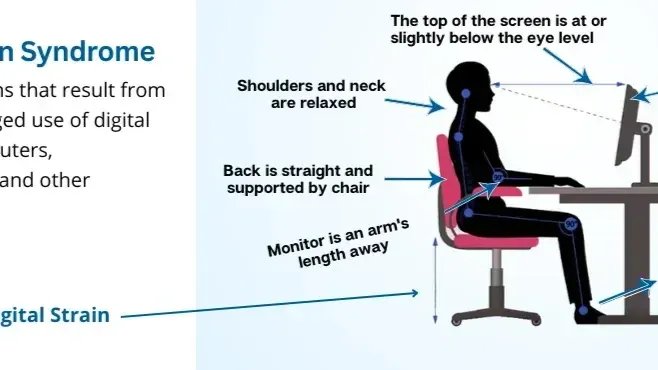
Position the top of the screen at or slightly below eye level, about an arm's length away, in a room lit to avoid glare and reflections.
Patients are coached to blink fully and deliberately during screen work, since incomplete blinks spread the tear film unevenly.
A useful comfort measure for some patients once the underlying refractive and dry-eye issues are addressed — see the honest answer on this below.
For patients whose strain traces back to convergence insufficiency or other binocular vision problems, structured vision therapy addresses the root cause rather than just the symptoms.
What Tests Are Done Before Computer Vision Syndrome?
Detailed history
Screen time, type of work, lighting, posture, and your existing eyewear.
Visual acuity test
Checks for any uncorrected near or distance refractive error.
Refraction
Confirms whether your current prescription actually matches your screen-viewing distance.
Tear film evaluation
Assesses dryness using tear break-up time and related tests.
Binocular vision & accommodation testing
Checks how well your eyes focus and work together — convergence and focusing problems often masquerade as "screen eye strain."
Eye health examination
Rules out other conditions that can mimic CVS symptoms.
What Are the Risks and Side Effects of Computer Vision Syndrome?
Chronic Dry Eye Disease
Chronic untreated dryness can progress toward more persistent dry eye disease.
Progressing Refractive Error
Ongoing eye strain can mask an uncorrected refractive error that's quietly worsening — a pattern linked to faster myopia progression with heavy near-screen work, particularly in children and young adults.
Headaches & Musculoskeletal Strain
Headaches and neck or shoulder pain associated with CVS often spill over into sleep quality and daily productivity.
Doctors for Computer Vision Syndrome
Dr. Rajeev Jain
Dr. Rajeev Jain founded Save Sight Centre and has cared for over 3,50,000 eyes across more than 25 years of practice. He trained in ophthalmology at Guru Nanak Eye Centre (affiliated with Maulana Azad Medical College, Delhi), later served as professor of clinical studies at the University of Adelaide, Australia, and is an elected governing council member of the Vitreoretina Society of India (VRSI).
Recognised for Quality Care

Frequently Asked Questions About Computer Vision Syndrome
The most effective computer vision syndrome treatment combines an accurate eyeglass or computer-lens prescription, lubricating eye drops for dryness, the 20-20-20 rule, and ergonomic screen positioning. At Save Sight Centre, our ophthalmologists tailor this combination after a comprehensive eye exam, since the right mix depends on whether your symptoms stem from dry eyes, focusing strain, or an uncorrected refractive error.
Computer vision syndrome usually eases within a few hours to a few days once you reduce continuous screen exposure and adopt habits like the 20-20-20 rule, though symptoms return quickly if screen habits don't change. At Save Sight Centre, we generally recommend a follow-up review within two to four weeks if dryness, headaches, or blurred vision haven't noticeably improved.
Yes, eyes recover well from typical screen-related strain and dryness once you rest them and follow proper eye care habits, and most patients seen at Save Sight Centre notice clear improvement within days. Long-standing untreated dryness or an uncorrected prescription can cause more persistent discomfort, which is why our team recommends an eye check-up rather than waiting it out indefinitely.
Sleep plays an important role in easing digital eye strain because it allows your eyes' surface and focusing muscles to rest and rehydrate overnight. Doctors at Save Sight Centre often see faster symptom relief in patients who pair 7–8 hours of sleep with reduced screen use before bedtime, though persistent symptoms despite good sleep are still worth getting examined.
For quick relief, follow the 20-20-20 rule, use preservative-free lubricating eye drops, and adjust your screen's brightness and distance immediately. For longer-lasting relief, Save Sight Centre recommends a comprehensive eye exam to rule out an uncorrected refractive error or dry eye disease that over-the-counter measures alone won't fix.
Blue light glasses may improve comfort for some people, but current research shows mixed and limited evidence that they meaningfully reduce digital eye strain on their own. At Save Sight Centre, we treat them as an optional comfort measure rather than a primary treatment, focusing first on accurate refraction, screen ergonomics, and dry eye management.
Computer vision syndrome itself does not cause permanent eye damage, since it's a functional strain response rather than a structural eye disease, and symptoms typically reverse with proper care. Save Sight Centre still recommends an eye exam if symptoms are frequent, because they can sometimes mask an underlying issue like progressing myopia or dry eye disease that needs ongoing management.
Preventing computer vision syndrome while working from home starts with positioning your screen about an arm's length away with the top at or slightly below eye level, taking a 20-second break every 20 minutes, and keeping the room well-lit without screen glare. Save Sight Centre also recommends an annual eye check-up for remote workers, since long uninterrupted screen hours at home often go unmonitored compared to an office setting.
See an eye specialist if digital eye strain symptoms like blurred vision, headaches, or dryness last more than a few days despite basic precautions, or if your vision seems to be worsening, since these can indicate an uncorrected refractive error or dry eye disease. Save Sight Centre recommends a comprehensive eye exam for anyone with daily screen-related discomfort rather than relying on home remedies alone.
Yes, computer vision syndrome and digital eye strain refer to the same group of symptoms caused by extended screen use, and eye care professionals, including the American Optometric Association, use the terms interchangeably. Save Sight Centre uses both terms on this page since patients commonly search using either one.
Ready to Book Your Computer Vision Syndrome Consultation?
Book your consultation at Save Sight Centre, Delhi. Our expert team will help you understand your condition, recommend the right treatment and guide you through every step.