
 +91-7873-222-000
 WhatsApp

 Book Appointment
Scleral Icterus (Yellow Eyes): Causes, Symptoms & Treatment Options
Noticing a yellow tint in the whites of your eyes is easy to dismiss as tiredness — but it's often the earliest visible sign that bilirubin, a natural byproduct of red blood cell breakdown, is building up in your body. Here's what scleral icterus actually is, why it happens, and what an eye doctor and physician will do about it together.

Quick Answer
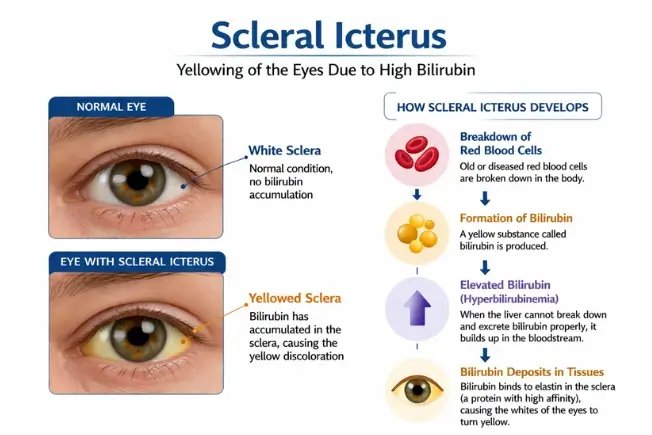
Scleral icterus is the yellow discoloration of the sclera (the white part of the eye), caused by a buildup of bilirubin — a yellow pigment made when old red blood cells break down. The sclera contains a tissue (elastin) that binds bilirubin especially strongly, which is why yellowing here often shows up before the skin turns yellow. It usually becomes visible once blood bilirubin crosses roughly 2-3 mg/dL. Causes range from harmless, temporary conditions like Gilbert syndrome to viral hepatitis, gallstones, and liver disease. Treatment always targets the underlying cause — as that's addressed, the yellowing gradually fades on its own.
Key Takeaways
- Scleral icterus is yellowing of the eye whites caused by elevated bilirubin, and is usually the first visible sign of a bilirubin problem.
- It typically becomes noticeable at bilirubin levels above roughly 2-3 mg/dL — well before skin yellowing appears.
- Causes fall into three categories: before the liver (hemolysis), in the liver (hepatitis, cirrhosis), and after the liver (bile duct blockage).
- Gilbert syndrome is a common, harmless genetic cause of mild, occasional yellowing.
- Urine and stool colour offer useful clues — dark urine and pale stool often point toward a bile duct blockage.
- Treatment targets the root cause; the yellowing itself resolves once bilirubin levels normalise.
Figures are general clinical reference points and can vary between individuals and lighting conditions.
What Is Scleral Icterus?
Scleral icterus refers to a yellow tint appearing in the sclera — the white part of the eye. It happens when bilirubin, a yellowish pigment formed as the body breaks down old or damaged red blood cells, builds up in the bloodstream faster than the liver can process and excrete it. Normally, bilirubin is broken down in the liver and passed out of the body through bile. When this process is disrupted — a state called hyperbilirubinemia — bilirubin starts depositing in body tissues. The sclera is often the first place this becomes visible, because it contains a protein-like substance called elastin that has a particularly strong attraction to bilirubin. As levels rise further, the rest of the skin begins to yellow too.
What's the Difference Between Scleral Icterus and Jaundice?
Scleral icterus — yellowing of the eye whites — is usually the earliest visible sign that bilirubin is rising. As bilirubin climbs further, the yellowing spreads to the skin and mucous membranes, at which point the broader term "jaundice" applies. In short: all jaundice involves scleral icterus at some point, but scleral icterus can appear well before jaundice becomes visible elsewhere on the body — which is exactly why an eye exam can catch a bilirubin problem early.
What Are the Types of Scleral Icterus?
Pre-Hepatic (Hemolytic) Icterus
Before the LiverOccurs when red blood cells break down faster than normal, as in hemolysis. This overwhelms the liver with unconjugated bilirubin it can't process quickly enough.
Hepatic (Hepatocellular) Icterus
Within the LiverCaused by damage to liver cells themselves, impairing their ability to process bilirubin. Commonly linked to viral infections, toxins, or fatty liver disease.
Post-Hepatic (Obstructive) Icterus
After the LiverOccurs when bile ducts are blocked by stones, tumours, or scarring, preventing already-processed bilirubin from being excreted, so it builds up in the bloodstream.
Two inherited conditions also cause scleral icterus and are worth knowing about specifically:
Gilbert Syndrome
A mild, inherited condition causing occasional bilirubin spikes, especially during fasting, stress, or illness. It's very common and generally considered harmless, needing no active treatment.
Dubin-Johnson Syndrome
A rare genetic disorder involving defective bilirubin transport within liver cells. It leads to persistently elevated conjugated bilirubin but usually doesn't cause other serious health issues.
What Causes Scleral Icterus?
The underlying causes are grouped by where the problem occurs relative to the liver:
Before the liver (pre-hepatic):
Hemolytic Disorders
Conditions like sickle cell disease, thalassemia, and G6PD deficiency destroy red blood cells faster than normal, overwhelming the liver's processing capacity.
Within the liver (hepatic):
Viral Hepatitis (A, B, C, E)
Causes inflammation of liver cells, making it harder for the liver to process bilirubin normally.
Cirrhosis and Fatty Liver Disease
Long-term alcohol use or fatty liver disease damages liver tissue over time, reducing its ability to function efficiently.
Drug-Induced Liver Injury
Certain medications, including high-dose paracetamol, can directly injure liver cells and impair bilirubin processing.
After the liver (post-hepatic):
Gallstones
Can obstruct the bile ducts, causing bilirubin to accumulate rapidly in the blood rather than being excreted normally.
Pancreatic or Bile Duct Tumours
Can slowly press on the bile ducts, causing gradual, often painless yellowing of the eyes alongside unexplained weight loss.
What Symptoms Come Along With Scleral Icterus?
Yellowing of the eyes is typically the earliest sign, becoming more pronounced as bilirubin rises further. Persistent fatigue is common because the liver can't filter toxins efficiently. Upper right abdominal pain often relates to liver inflammation or gallstones. Itching from bile salt buildup under the skin tends to worsen at night and doesn't respond well to scratching. Dark, tea-coloured urine is one of the more noticeable early systemic signs. Nausea, reduced appetite, and gradual weight loss reflect the digestive system being affected by liver dysfunction, and some people also notice a persistent bitter taste from bile imbalance.
What Can Urine and Stool Colour Tell You About the Cause?
This is a genuinely useful, often overlooked clue. Dark, tea-coloured urine usually means the cause allows bilirubin to pass into urine — typically liver disease or a bile duct blockage. In hemolytic (pre-hepatic) causes, however, urine often stays a normal colour, since that type of bilirubin can't dissolve in water and pass into urine. Pale, clay-coloured stools often point toward a bile duct blockage, since bile isn't reaching the intestines to give stool its usual brown colour — this pattern is a helpful signal for post-hepatic causes like gallstones or a tumour pressing on the duct.
At What Bilirubin Level Does Yellowing Become Visible?
| Sign | Approximate Bilirubin Level |
|---|---|
| Scleral icterus (eyes) | Above ~2-3 mg/dL |
| Skin jaundice | Above ~5-7 mg/dL |
| Newborn phototherapy typically considered | Above ~15 mg/dL |
| Newborn kernicterus risk rises | Above ~20-25 mg/dL |
The sclera contains elastin, which binds bilirubin more readily than skin — this is exactly why the eyes tend to yellow first. Interestingly, research shows even experienced examiners sometimes miss mild scleral icterus at the lower end of this range, which is one more reason a proper blood test matters more than a mirror check.
When Should You See a Doctor Urgently?
Any new yellowing of the eyes deserves a prompt medical evaluation. Treat it as urgent, rather than waiting, if it comes with:
- Fever alongside the yellowing
- Severe or worsening abdominal pain
- Confusion or drowsiness — can indicate the liver is struggling to clear toxins
- Unusual bleeding or bruising
- A rapidly swelling abdomen
- Sudden onset of yellowing rather than a gradual change
How Is Scleral Icterus Diagnosed?
Liver Function Tests
Measures liver enzymes and total bilirubin to assess how well the liver is functioning.
Bilirubin Fractionation
Breaks bilirubin down into direct (conjugated) and indirect (unconjugated) components, which helps narrow down whether the cause is pre-, intra-, or post-hepatic.
Complete Blood Count & Hemolysis Screen
Checks for red blood cell breakdown or anaemia, pointing toward a pre-hepatic cause.
Viral Hepatitis Panel
Tests specifically for hepatitis A, B, C, and E infection.
Abdominal Ultrasound
Checks the liver, gallbladder, and bile ducts for stones, blockages, or structural changes.
What Are the Treatment Options for Scleral Icterus?
Treatment always depends entirely on the underlying cause — scleral icterus itself is a sign, not a standalone disease. Once the root cause is addressed, the yellowing gradually fades.
Antiviral therapy
For hepatitis B, medications like tenofovir or entecavir suppress the virus, allowing the liver to recover, though they don't cure the infection outright. Newer direct-acting antivirals can typically cure hepatitis C within 8-12 weeks. Hepatitis A and E are usually self-limiting, managed with rest and supportive care.
Ursodeoxycholic acid (UDCA)
Thins bile and can dissolve small cholesterol gallstones in mild blockages, improving bile flow. Also used in certain chronic liver conditions like primary biliary cholangitis.
ERCP (Endoscopic Retrograde Cholangiopancreatography)
A procedure using a thin, flexible camera-equipped tube to reach the bile duct opening — allowing doctors to remove stones, place stents to keep the duct open, or take tissue samples.
Blood transfusions and folate
Used for hemolytic disorders like sickle cell disease during a crisis, alongside hydroxyurea to help prevent future crises.
Steroids or immunosuppressants
Used in some severe autoimmune hemolytic anaemias, to reduce the immune system's destruction of red blood cells.
Phototherapy (newborns)
Used in infants with significantly elevated bilirubin to help break it down and prevent complications such as kernicterus.
What Is Save Sight Centre's Role in Detecting Scleral Icterus?
Ophthalmologists at Save Sight Centre routinely examine patients' eyes for signs of scleral icterus during regular check-ups. Because eye yellowing can appear before other symptoms are obvious, a routine eye visit can be the first step toward diagnosing an underlying liver or blood condition. The centre works closely with gastroenterologists and hepatologists to ensure timely, coordinated follow-up care.
On-site laboratories offer bilirubin profiling, liver function tests, and complete blood counts, along with ultrasound imaging — so patients don't need to travel elsewhere for initial workup. For patients requiring ongoing monitoring, particularly those with hepatitis B or C, the wider care team tracks viral loads and treatment response through regular follow-up testing.
Dr. Shuchi GuptaCataract (Phacoemulsification) · LASIK · Glaucoma · Anterior Segment Specialist
"As ophthalmologists, we're often the first to notice a yellow tint patients themselves haven't clocked yet — sometimes during a completely routine eye check. I always tell patients: this isn't an eye problem we're treating, it's an eye sign pointing us toward something elsewhere in the body. Catching it early, and looping in the right specialist quickly, makes a real difference to how smoothly things resolve."
Frequently Asked Questions About Scleral Icterus
Scleral icterus typically becomes visible once blood bilirubin rises above roughly 2-3 mg/dL, since the sclera contains a protein-like tissue (elastin) that binds bilirubin earlier and more strongly than skin does. Yellowing of the skin usually needs a higher level, around 5-7 mg/dL, to become noticeable.
Scleral icterus — yellowing of the whites of the eyes — is usually the earliest visible sign of rising bilirubin. As bilirubin levels climb further, the yellowing spreads to the skin and other tissues, which is when the broader term "jaundice" applies.
Mild scleral icterus and skin jaundice are very common in newborns because their livers are still maturing. It typically peaks around days 3-5 and clears within about two weeks. If bilirubin climbs above roughly 15 mg/dL, doctors may recommend phototherapy to prevent complications such as kernicterus, a rare but serious form of brain injury from very high bilirubin.
Not usually. Most causes of scleral icterus — including hepatitis, gallstones, and Gilbert syndrome — are managed with medication, minor procedures, or simply monitoring. A transplant is only considered in severe, advanced liver disease such as decompensated cirrhosis or certain liver cancers, where the liver itself can no longer function.
Yes, for the causes linked to viral hepatitis. Vaccination against hepatitis A and hepatitis B can prevent the liver infections that commonly lead to jaundice and scleral icterus. It won't prevent icterus caused by non-viral factors like gallstones, hemolysis, or genetic conditions.
The yellowing itself doesn't cause pain or discomfort in the eye. Any pain associated with scleral icterus usually comes from the underlying cause — for example, upper right abdominal pain from gallstones or liver inflammation — rather than from the eyes themselves.
Often, yes. Once the underlying cause is treated — whether that's clearing a viral infection, removing a gallstone, or letting a mild bilirubin spike from Gilbert syndrome pass — bilirubin levels drop and the yellowing of the eyes gradually fades. How quickly it resolves depends entirely on the cause and how promptly it's treated.
No. Many forms of liver disease, including early-stage fatty liver disease or mild hepatitis, don't raise bilirubin enough to cause visible yellowing. Scleral icterus tends to appear at a more advanced stage or when the liver's ability to process bilirubin is significantly impaired.
It's a genuinely useful clue. Dark, tea-coloured urine usually points to a cause where bilirubin can pass into urine, such as liver disease or a blocked bile duct — while urine tends to stay normal-coloured in hemolytic causes. Pale, clay-coloured stools often suggest a bile duct blockage, since bile isn't reaching the intestines to give stool its usual brown colour.
Rarely, yes. A condition called carotenemia, from eating very large amounts of carotene-rich foods like carrots, can give the skin a yellowish-orange tint, but it does not affect the sclera the way true scleral icterus does. Ageing eyes can also develop a slightly yellowish or fatty deposit (pinguecula) that's sometimes mistaken for icterus. A proper eye and blood examination reliably tells the difference.
Noticed Yellowing in Your Eyes?
Get a thorough eye exam and coordinated referral for bilirubin testing at Save Sight Centre, Adarsh Nagar, North Delhi. NABH & ISO accredited · 15+ years · 1,70,000+ patients treated.
Disclaimer: The information on this site should not be considered medical advice. Please consult a doctor for an accurate diagnosis and treatment plan. Results and bilirubin thresholds may vary from person to person, and this page does not guarantee similar outcomes for everyone.