
 +91-7873-222-000
 WhatsApp

 Book Appointment
Nystagmus: Causes, Symptoms & Treatment for Eye Shaking
Have you noticed someone's eyes moving rapidly or uncontrollably from side to side? This condition is known as nystagmus, and it can significantly affect vision, balance, and daily life. It's more than just unusual eye movement — but with proper diagnosis and management, many people go on to live full, independent lives with good functional vision.

Quick Answer
Nystagmus is a condition of involuntary, repetitive eye movements — side-to-side, up-and-down, or circular — that prevent the eyes from focusing steadily, causing blurred or shaky vision. It's classified as congenital (present from infancy, usually not dangerous) or acquired (developing later in life, often linked to a neurological or inner ear condition and needing prompt evaluation). Many people with nystagmus find a "null point" — a specific gaze direction where the movement slows and vision sharpens — which is why they may turn or tilt their head. There's no universal cure, but glasses, prism lenses, medication, vision therapy, and in some cases surgery can meaningfully improve vision and reduce abnormal head posture.
Key Takeaways
- Nystagmus affects roughly 1 in 1,000 people, making it one of the more common eye movement disorders.
- Congenital nystagmus usually isn't dangerous; acquired nystagmus (developing later in life) often signals an underlying neurological or inner ear issue.
- The "null point" is the gaze direction where nystagmus is minimised — head turning or tilting is an adaptive response to find it, not a habit.
- Most people with congenital nystagmus don't perceive oscillopsia (the world appearing to shake); most people with acquired nystagmus do.
- Movement patterns are classified as jerk (slow drift, fast correction) or pendular (smooth back-and-forth).
- Treatment ranges from glasses and prism lenses to medication (gabapentin, memantine) and, in select cases, the Kestenbaum-Anderson surgical procedure.
Figures reflect published clinical research and can vary based on population and diagnostic method.
What Is Nystagmus?
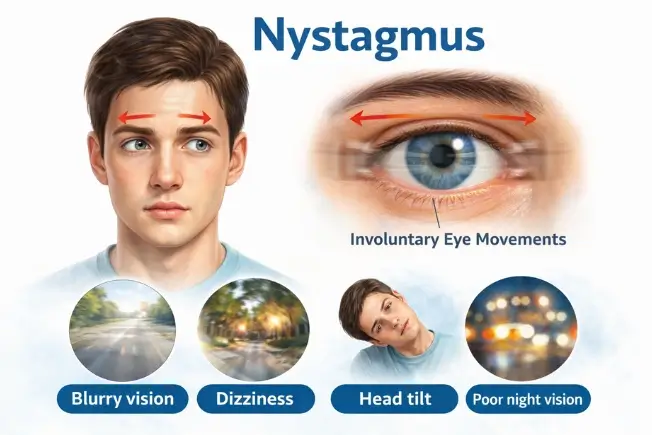
Nystagmus is a condition characterised by involuntary, repetitive eye movements. These movements can be side-to-side (horizontal), up and down (vertical), or circular (rotary). Because of these uncontrolled movements, the eyes cannot focus steadily on objects, leading to blurred or unstable vision.
What Are the Movement Patterns of Nystagmus?
Beyond the direction of movement, doctors also classify nystagmus by its waveform — the specific rhythm the eyes follow:
Jerk Nystagmus
Most CommonThe eyes drift slowly in one direction, then snap back quickly in a fast corrective movement — giving it a distinct, asymmetric rhythm. This is the more commonly seen pattern overall.
Pendular Nystagmus
Smooth OscillationThe eyes move smoothly back and forth at a similar speed in both directions, resembling a swinging pendulum rather than a drift-and-snap pattern.
Both patterns can appear in congenital or acquired nystagmus, and identifying which one a person has helps guide which treatment — including specific medications — is most likely to help.
What Is a "Null Point," and Why Do People With Nystagmus Tilt Their Head?
Many people with nystagmus have a specific direction of gaze — called the null point or null zone — where their eye movement slows down and their vision becomes noticeably clearer. To make use of this, people often unconsciously turn or tilt their head so their eyes naturally rest in this position, since it genuinely gives them their best possible vision. This is an adaptive response, not a habit or tic worth correcting on its own. If left unaddressed over many years, a pronounced head turn can occasionally contribute to neck or spine strain, which is why prism lenses or, in select cases, surgery to shift the null point are sometimes recommended.
How Does Nystagmus Affect Vision and Daily Life?
Nystagmus can impact vision in multiple ways because the eyes are unable to stay steadily focused on a single point.
In normal vision, the eyes remain steady so light focuses clearly on the retina. In nystagmus, continuous eye movement causes the image to constantly shift, which can affect reading and learning (slower reading, trouble tracking lines of text), driving (difficulty judging distances, less confidence at night), screen use (eye strain, needing larger fonts), and social interaction (difficulty maintaining eye contact, sometimes misread by others as inattention).
What Are the Types of Nystagmus?
Congenital (Infantile) Nystagmus
Appears in early infancy, usually between 6 weeks and 3 months of age. Present from birth or early childhood, often associated with vision development issues, and typically horizontal in direction. Children with congenital nystagmus may not realise they have the condition, as their brain adapts over time.
Acquired Nystagmus
Develops later in life due to neurological disorders, head injury, inner ear problems, or certain medications. Often more noticeable than the congenital form and may be accompanied by dizziness or imbalance.
Vestibular Nystagmus
Related to the inner ear (vestibular system), which controls balance. Symptoms include vertigo, nausea, and balance issues.
Optokinetic Nystagmus
A normal reflex seen when watching moving objects, such as looking out of a moving train window or watching scrolling visuals. It is not a disease but a natural eye response.
Congenital vs Acquired Nystagmus: What's the Key Difference?
| Feature | Congenital | Acquired |
|---|---|---|
| Onset | Birth to ~3 months | Any age, later in life |
| Oscillopsia (world appears to shake) | Usually absent | Usually present |
| Common causes | Albinism, foveal hypoplasia, often idiopathic | Neurological, inner ear, trauma, medication |
| Dizziness/imbalance | Uncommon | Common |
| Urgency of evaluation | Routine paediatric workup | Prompt neurological evaluation recommended |
The absence of oscillopsia in most congenital cases is one of the clearest practical differences — it's why many people with lifelong nystagmus don't feel like their world is shaking, even though their eyes are visibly moving.
What Causes Nystagmus?
Nystagmus can occur due to a wide range of factors:
- Eye-related causes: Congenital cataract, albinism, optic nerve problems, refractive errors
- Neurological causes: Brain disorders, stroke, multiple sclerosis, tumours
- Inner ear disorders: Vestibular dysfunction, labyrinthitis
- Other causes: Head trauma, medication side effects, alcohol or drug use
What Are the Symptoms of Nystagmus?
Symptoms vary depending on severity and type:
In acquired cases, symptoms like dizziness and nausea are also common, reflecting the shared brain and inner-ear pathways that control both eye movement and balance.
How Is Nystagmus Diagnosed?
Diagnosis involves a comprehensive eye examination and sometimes additional tests, including visual acuity testing, eye movement recording, refraction testing, retinal examination, and neurological evaluation. In some cases, imaging tests like MRI may be required to identify underlying causes, particularly for acquired nystagmus in adults.
What Are the Treatment Options for Nystagmus?
There is no universal cure for nystagmus, but several treatments can help manage symptoms and improve vision.
Glasses and Contact Lenses
Correcting refractive errors can significantly improve vision clarity. Special lenses may also help reduce abnormal head posture.
Prism Lenses
Can optically shift the null point, allowing a person to benefit from their clearest vision without needing to hold an uncomfortable head turn.
Medications
Gabapentin and memantine are used to help reduce oscillation in some acquired forms, particularly acquired pendular nystagmus, when linked to a neurological cause.
Vision Therapy
Structured exercises can help improve eye coordination, focus, and visual stability.
Kestenbaum-Anderson Surgery
A specific eye muscle procedure that repositions the extraocular muscles to shift the null point toward straight-ahead gaze, reducing the need for an abnormal head turn and sometimes reducing nystagmus outside the null zone too.
Treating the Underlying Cause
If nystagmus is caused by another condition — such as a neurological or inner ear disorder — treating that condition directly can improve symptoms.
What Should Parents Know About Nystagmus in Children?
Early detection is crucial for children. Signs parents should watch for include unusual eye movements, difficulty focusing, and delayed visual response. Timely intervention can help improve visual development and learning abilities.
Why Choose Save Sight Centre for Eye Shaking Treatment?
Choosing the right eye care centre for nystagmus (eye shaking) is important because it needs accurate diagnosis and personalised treatment. At Save Sight Centre, experienced eye specialists treat both children and adults with advanced technology to find the exact cause of involuntary eye movements. We check eye movements, vision clarity, and overall eye health to ensure the right diagnosis, then create customised treatment plans including glasses, contact lenses, vision therapy, medicines, or surgery if needed.
Dr. Rajeev JainDirector · Retina, Cataract, LASIK & Uvea Specialist
"Parents are often relieved to learn that a head tilt in a child with nystagmus isn't something to 'correct' by telling them to sit up straight — it's their eyes finding the position that gives them the clearest vision. Once families understand that, the focus shifts to the right question: is this congenital and likely to stabilise, or does it need a broader neurological work-up? That distinction genuinely shapes everything that follows."
Frequently Asked Questions About Nystagmus
Nystagmus, often called eye shaking, is a condition where the eyes move involuntarily in repetitive patterns such as side-to-side, up and down, or circular motions. These uncontrolled movements can affect focus, depth perception, and visual clarity, making it harder to maintain steady vision during daily activities.
Nystagmus is usually not dangerous, especially when present from birth (congenital). However, if it develops later in life (acquired nystagmus), it may indicate an underlying neurological or inner ear issue. In such cases, timely evaluation by an eye specialist is important to identify and treat the root cause.
A null point (or null zone) is the specific direction of gaze where a person's nystagmus slows down and their vision is clearest. Many people unconsciously turn or tilt their head to shift their eyes into this position, since it genuinely gives them their best possible vision — it isn't a habit or tic, but an adaptive response. If uncorrected over years, this head posture can occasionally contribute to neck strain, which is one reason it's sometimes addressed directly with prisms or surgery.
Oscillopsia is the sensation that the surrounding world is moving or shaking, even though it's actually still. Interestingly, most people with congenital (infantile) nystagmus do not experience oscillopsia, since their brain adapts early in life to filter out the effect of the eye movement. People with acquired nystagmus, on the other hand, commonly do experience oscillopsia, since their brain hasn't had the same lifelong adaptation — which is one of the clearest practical differences between the two forms.
Congenital nystagmus often stabilizes as a person grows, and the brain adapts to improve visual function over time. However, acquired nystagmus may worsen if the underlying cause — such as a neurological condition or medication side effect — is not treated. Regular eye check-ups help monitor and manage progression effectively.
Nystagmus usually does not go away completely, especially in congenital cases. However, treatment options like glasses, contact lenses, vision therapy, or surgery can significantly improve symptoms. Managing underlying causes in acquired cases may also reduce or control eye movements effectively.
These describe the pattern, or waveform, of the eye movement itself. Jerk nystagmus has a slow drift in one direction followed by a fast corrective movement back, giving it a distinct rhythm. Pendular nystagmus moves smoothly back and forth at a similar speed in both directions, like a swinging pendulum. Both patterns can occur in congenital or acquired nystagmus, and identifying which type a person has helps guide treatment choices.
Sudden or acquired nystagmus can be caused by inner ear disorders, neurological conditions, head injury, stroke, medications, or alcohol use. It happens when coordination between the brain, eyes, and balance system is disrupted. Any sudden onset should be evaluated to rule out serious underlying causes.
Yes, nystagmus is often linked to the brain or inner ear (vestibular system), which control eye movement and balance. When these systems don't work together properly, it can result in uncontrolled eye movements and symptoms like dizziness or poor coordination.
The Kestenbaum-Anderson procedure is a specific eye muscle surgery used for nystagmus with an off-centre null point. It repositions the eye muscles to shift the null point toward straight-ahead gaze, which reduces or eliminates the need for an abnormal head turn to achieve the clearest vision, and can also reduce the nystagmus itself outside the null zone.
No, they are different conditions. Eye twitching (myokymia) is a minor eyelid spasm that's usually harmless, while nystagmus (eye shaking) involves actual movement of the eyeball itself and may affect vision. Nystagmus is typically more complex and may require medical evaluation.
Yes, congenital (infantile) nystagmus can be present at birth or develop within the first few months of life. It is often mild and may not worsen over time. Many children adapt well, although they may need glasses or visual support.
Excessive screen time can worsen symptoms like eye strain and fatigue, which may make nystagmus more noticeable. Taking regular breaks and following the 20-20-20 rule can help reduce strain and improve visual comfort.
Noticed Uncontrolled Eye Movement in Yourself or Your Child?
Get an accurate diagnosis and personalised treatment plan at Save Sight Centre, Adarsh Nagar, North Delhi. NABH & ISO accredited · 15+ years · 1,70,000+ patients treated.
Disclaimer: The information on this site should not be considered as medical advice. Please consult a doctor for determining the best procedure as well as the most appropriate treatment for your eyes. The results may vary from person to person and we do not guarantee similar results for everyone.