

 +91-7873-222-000
 WhatsApp

 Book Appointment
Lazy Eye (Amblyopia): Causes, Symptoms, Types & Treatment for Kids and Adults
Lazy eye isn't about a weak eye muscle — it's about the brain quietly learning to favour one eye over the other during childhood. Left unaddressed, it's the leading cause of vision loss in children worldwide. Caught early, it's also one of the most treatable. Here's what actually causes it, how to spot it, and what treatment looks like at any age.

Quick Answer
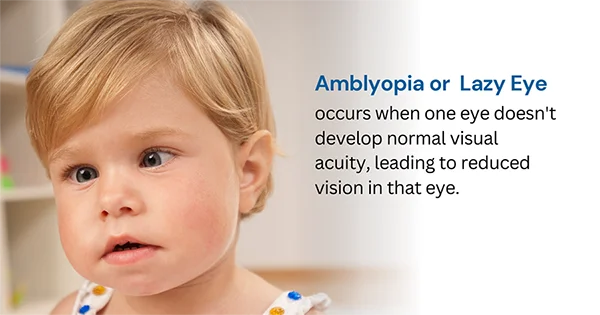
Lazy eye, medically called amblyopia, happens when one eye doesn't develop normal vision during early childhood, so the brain starts favouring the stronger eye and partly ignores signals from the weaker one. It's caused by strabismus (misaligned eyes), a significant refractive difference between the eyes, or an obstruction like a childhood cataract blocking normal visual development. It's the leading cause of vision loss in children, affecting roughly 1-4% of the population, but treatment — patching, atropine drops, corrective lenses, vision therapy, or surgery — works best when started before age 7-8, and can still help older children, teens, and even adults.
Key Takeaways
- Amblyopia is a brain-based vision problem, not an eye muscle problem — the brain learns to favour one eye over the other.
- The three main types are strabismic, refractive (anisometropic), and deprivation amblyopia.
- It's the single leading cause of childhood vision loss, affecting an estimated 1-4% of people.
- The critical window for the most effective treatment runs roughly from birth to age 7-8, though benefit is possible well beyond that.
- Left untreated, amblyopia can cause permanent, uncorrectable vision loss in the affected eye.
- Treatment ranges from patching and atropine drops to glasses, vision therapy, and surgery — often used in combination.
Figures reflect general epidemiological research and can vary; your child's specific outlook depends on the type and timing of diagnosis.
What Exactly Is Lazy Eye (Amblyopia)?
Lazy eye is a vision condition where one eye doesn't develop normal visual acuity during early childhood, even though the eye itself is often structurally healthy. The real problem isn't in the eye — it's in the brain. When the brain consistently receives a clearer, stronger signal from one eye and a blurrier or mismatched one from the other, it gradually starts favouring the stronger eye and suppressing input from the weaker one. Over time, the visual pathway for the weaker eye simply doesn't develop properly, leading to reduced vision, poor depth perception, and overall visual impairment that glasses alone often can't fully correct.
Why Does Age Matter So Much in Treating Lazy Eye?
A child's visual system is remarkably adaptable in the first several years of life — a property doctors call neuroplasticity. This creates a "critical period," roughly from birth to age 7-8, during which the brain's visual pathways are still forming and are most responsive to treatment. Starting treatment within this window generally gives the best results. That said, the critical period isn't a hard cut-off: children aged 7 to 12 can still meaningfully benefit from treatment, and research along with real clinical experience shows that teens and even adults can achieve genuine improvement with dedicated therapy, even if the pace and extent of recovery is usually slower than in early childhood.
What Are the Types of Amblyopia?
Strabismic Amblyopia
Most CommonDevelops when the eyes are misaligned (strabismus), so the brain receives two different images. To avoid seeing double, it suppresses the image from the misaligned eye, which weakens over time.
Refractive (Anisometropic) Amblyopia
CommonOccurs when there's a significant, unequal difference in refractive error between the two eyes — one eye is far more near-sighted, far-sighted, or astigmatic than the other — causing the brain to favour the clearer image.
Deprivation Amblyopia
Most SevereThe least common but most serious type, caused by something physically blocking clear vision early in life — most often a congenital cataract, but also a drooping eyelid (ptosis) or corneal cloudiness. Because it interferes with visual development from the very start, it needs the most urgent attention.
What Causes Lazy Eye?
Strabismus (Crossed or Misaligned Eyes)
When the eyes point in different directions, the brain suppresses the image from one eye to avoid double vision, leading to strabismic amblyopia. Learn more about squint (strabismus) treatment.
Refractive Errors
A significant imbalance in near-sightedness, far-sightedness, or astigmatism between the two eyes prevents one eye from ever focusing as clearly as the other, even with glasses.
Family History
If amblyopia, strabismus, or significant refractive errors run in the family, a child's risk of developing lazy eye is higher, making early and regular screening especially important.
Ptosis (Drooping Eyelid)
A drooping upper eyelid that partially or fully covers the pupil can physically block normal visual development in that eye. Learn more about ptosis treatment.
Congenital Cataract or Corneal Cloudiness
A cataract or cloudy cornea present from birth or early infancy blocks clear images from reaching the retina, causing deprivation amblyopia — the most urgent type to treat.
Premature Birth
Babies born prematurely have a higher risk of developing amblyopia and related eye conditions, making early paediatric eye screening particularly valuable for this group.
What Are the Symptoms of Lazy Eye?
Detecting amblyopia early is crucial for successful treatment. Watch for:
A genuinely important point: many children with amblyopia show no obvious outward signs at all, especially with milder refractive causes, since a young child has no way of knowing their vision "should" look different. This is exactly why routine, scheduled screening matters more than waiting for a child to complain.
How Common Is Lazy Eye, and Why Does Screening Matter So Much?
Amblyopia affects an estimated 1 to 4% of people and is considered the leading cause of vision loss in children worldwide — yet it's highly treatable when caught early, and largely preventable from becoming permanent. Health bodies generally recommend:
- A newborn eye check within the first weeks of life, to catch obstruction-related causes like congenital cataract
- At least one formal vision screening between ages 3 and 5, before the critical developmental window narrows
- Earlier and more frequent screening for children with a family history of amblyopia or strabismus, or those born prematurely
How Is Amblyopia Diagnosed?
A thorough eye exam for amblyopia goes well beyond reading letters on a chart. Your eye specialist will typically:
- Test how clearly each eye sees independently, to compare visual acuity between the two
- Check how well the eyes align and work together, looking for any strabismus
- Measure the refractive power of each eye separately, to identify any significant imbalance
- Examine the internal structures of the eye, ruling out a cataract or other obstruction
- Prescribe and verify glasses if needed, since correcting refractive error is often the first step in treatment
What Are the Treatment Options for Lazy Eye?
Treatment is tailored to the type and severity of amblyopia, and the goal is always the same: help the weaker eye see better and get both eyes working well together.
Eye Patching
Covering the stronger eye for part of the day forces the brain to rely on and strengthen the weaker eye — one of the most established and effective treatments available.
Atropine Eye Drops
An alternative to patching, these drops temporarily blur vision in the stronger eye, achieving a similar effect by encouraging the brain to use the weaker eye more.
Glasses or Contact Lenses
Correcting an underlying refractive error is often the essential first step, ensuring both eyes can focus as clearly as possible before other treatments begin.
Vision Therapy and Eye Exercises
Structured activities and games, guided by an optometrist, actively train the weaker eye and help both eyes coordinate better together.
Surgery
Needed when there's a structural cause — correcting significant strabismus, removing a congenital cataract, or repairing ptosis that's blocking vision.
For families: Consistency matters more than any single treatment choice. Encouragement, patience, and sticking with the prescribed patching or drop schedule make a genuine difference to how well and how quickly treatment works.
Can Lazy Eye Be Treated in Adults?
Yes — this is one of the most persistent myths about amblyopia. While the brain's plasticity is highest in early childhood, meaning children generally see faster and more complete results, adults are not without options. Vision therapy, corrective lenses, and in select cases patching, can still lead to measurable improvement in visual acuity and binocular vision in teens and adults, particularly if amblyopia wasn't previously treated. Results tend to be more modest and take longer than in children, but "it's too late" is rarely the accurate takeaway.
What Happens If Lazy Eye Is Left Untreated?
Amblyopia rarely improves on its own. Left unaddressed through the critical years of visual development, the weaker eye's vision loss can become permanent and largely uncorrectable — even with the best glasses or contact lens prescription. In practical terms, this can mean the affected eye never develops good enough vision to be relied upon, which also raises the stakes if something later happens to the stronger, dominant eye. This is exactly why early detection and consistent treatment matter so much, and why "watching and waiting" isn't a safe strategy once amblyopia is suspected.
What's the Emotional Impact of Living With Lazy Eye?
Amblyopia isn't just a vision issue — it can affect confidence and daily life too, for both children and adults. Kids may feel self-conscious about how their eyes look or perform, which can affect confidence and willingness to join in activities. Reading the board at school or focused schoolwork can be genuinely harder with reduced vision in one eye. Patient, open communication from family, along with consistent encouragement through treatment, makes a real difference — and if emotional struggles feel significant, involving a counsellor or psychologist alongside eye treatment is a reasonable and valuable step, not an overreaction.
What Are the Most Common Myths About Lazy Eye?
- "It's always inherited." Genetics can play a role, but refractive errors and eye misalignment contribute just as much, often with no family history at all.
- "It only affects children." It typically develops in childhood, but can go undetected and continue affecting vision and quality of life well into adulthood.
- "It can't be treated after childhood." Treatment becomes harder with age, but meaningful improvement remains genuinely possible in teens and adults.
- "Patching is the only treatment." Atropine drops, corrective lenses, vision therapy, and surgery are all legitimate options, often used together.
- "It's always visible." Many cases, especially refractive amblyopia, show no obvious outward sign at all — which is why screening matters.
Dr. Rajeev JainDirector · Retina, Cataract, LASIK & Uvea Specialist
"Parents often ask me how a child's eye can look completely normal and still have a serious vision problem — and that's exactly the trap with amblyopia. It hides in plain sight. The one thing I'd want every parent to take away is this: don't wait for your child to complain about their vision. Get that first screening done on schedule, because the window where treatment works best genuinely does narrow with time."
Frequently Asked Questions About Lazy Eye (Amblyopia)
Yes, it can be treated in adults, although treatment might take longer and results may vary compared to treatment in children. The brain's plasticity, or ability to rewire itself, is highest in early childhood, but research and clinical experience both show that meaningful improvement in visual acuity and binocular vision is still achievable in teens and adults.
No, it can also be caused by factors like strabismus (misalignment of the eyes) or a physical obstruction blocking vision, such as a childhood cataract or drooping eyelid (ptosis), which is called deprivation amblyopia. Amblyopia can also result from a combination of these causes.
It rarely resolves on its own. Because the brain has effectively learned to rely on the stronger eye and partly ignore signals from the weaker one, that pattern typically needs active treatment to reverse. Early detection and appropriate treatment are essential for genuine improvement.
Yes, vision exercises can be effective in treating lazy eye, especially when done under the guidance of an eye care professional and combined with other treatments like patching or corrective lenses. They work by encouraging the brain to actively engage and strengthen the weaker eye.
There isn't a strict cut-off. The critical period when the visual system is most responsive to treatment runs roughly from birth to age 7-8, and outcomes are generally best when treatment starts early in this window. That said, children aged 7 to 12 can still meaningfully benefit from treatment, and even teens and adults have shown improvement with dedicated therapy — so "too late" is rarely the right way to think about it.
They're related but not the same thing. Strabismus (squint) is a physical misalignment of the eyes — they point in different directions. Amblyopia (lazy eye) is what happens in the brain as a result: when the two eyes send mismatched images, the brain starts favouring one eye and suppressing the other, weakening vision in the suppressed eye over time. Strabismus is one of the most common causes of amblyopia, but amblyopia can also happen without any visible eye misalignment at all.
This varies by severity and is decided individually by your eye specialist — anywhere from 2 to 6 hours a day is common, rather than the whole day in most cases. Wearing it consistently as prescribed matters more than wearing it for very long stretches, since the brain needs regular, repeated practice using the weaker eye.
Screen time itself doesn't directly cause amblyopia, which stems from strabismus, a refractive imbalance between the eyes, or an obstruction to vision in early childhood. However, excessive screen time is linked to other vision problems like myopia and eye strain, so balanced screen habits remain a good idea for overall eye health regardless.
Yes, recurrence is possible, especially if treatment is stopped abruptly rather than gradually tapered off under a doctor's guidance. This is why eye specialists typically recommend continued monitoring for a period after treatment ends, even once vision has improved, to catch and address any regression early.
Health bodies generally recommend vision screening at least once between ages 3 and 5, in addition to a newborn eye check shortly after birth to catch obstruction-related causes like cataract. Children with a family history of amblyopia or strabismus, or those born prematurely, often benefit from earlier and more frequent screening.
Worried About Your Child's Vision — or Your Own?
Get a thorough amblyopia evaluation for kids and adults at Save Sight Centre, Adarsh Nagar, North Delhi. NABH & ISO accredited · 15+ years · 1,70,000+ patients treated.
Disclaimer: The information on this site should not be considered medical advice. Please consult a doctor for determining the best procedure as well as the most appropriate treatment for your eyes. Results may vary from person to person and we do not guarantee similar results for everyone.