
 +91-7873-222-000
 WhatsApp

 Book Appointment
Hyperopia (Farsightedness): Causes, Symptoms & Treatment Options
Do nearby things look blurry while distant objects stay sharp? Do your eyes feel tired after reading, or do you get headaches after screen time? That's hyperopia — one of the most common, and most overlooked, vision problems.
Quick Answer
Hyperopia, commonly called farsightedness, is a refractive error where you see distant objects more clearly than nearby ones. It happens because the eyeball is slightly too short or the cornea too flat, so light focuses behind the retina instead of directly on it. It's not a disease — it's a focusing disorder, usually genetic, and is very common, especially in young children whose eyes often compensate for it naturally. Left uncorrected, it can cause eye strain, headaches, and in children, an increased risk of lazy eye. Glasses, contact lenses, LASIK, and lens implants can all correct it.
Key Takeaways
- Hyperopia isn't a disease — it's a structural focusing disorder, usually present from birth and largely genetic.
- It happens when the eyeball is too short or the cornea too flat, so light focuses behind the retina instead of on it.
- Most babies are mildly farsighted at birth, and it often improves naturally as the eyes grow.
- Common symptoms include blurry near vision, eye strain, headaches, squinting, and — in children — crossed eyes.
- Uncorrected hyperopia in children raises the risk of amblyopia (lazy eye), making early eye exams important.
- Treatment ranges from glasses and contact lenses to LASIK and lens implants, depending on severity and age.
What Is Hyperopia (Farsightedness)?
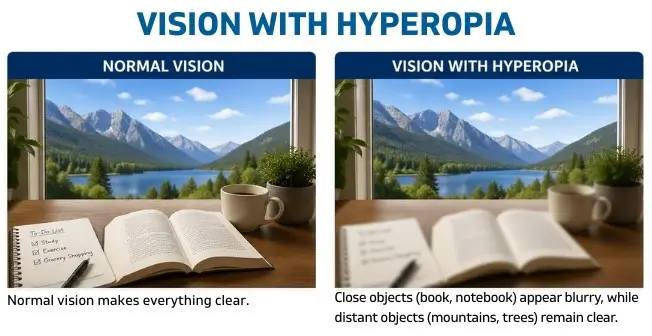
Hyperopia is a condition where you can see things far away more clearly than things up close. You can read a billboard across the street, but the book in your hands looks blurry. You can recognise someone's face at a distance, but reading a text message is a struggle.
Importantly, hyperopia isn't an eye disease — it's a refractive error, an eye-focusing disorder. That distinction matters: diseases typically involve infection or deterioration, while hyperopia is simply about how your eye's structure bends light. Unlike myopia (nearsightedness), which gets talked about more, hyperopia usually gets less attention — partly because many people, especially children, can still see clearly for a while as their eyes compensate for it.
How common is hyperopia? Very. Estimates suggest roughly 1 in 4 people have some degree of it. It's harder to catch on standard vision screenings — like the ones done in schools — than myopia, because farsighted eyes often still read the distance chart clearly. That's exactly why a full eye exam, not just a chart test, matters.
Why Does Hyperopia Happen?
Your eye works a lot like a camera. Light enters through the front, gets bent (focused) by the cornea and lens, and lands on the retina at the back to produce a clear image. In a healthy eye, this happens perfectly. In a hyperopic eye, one of two things is slightly off:
When the eyeball is shorter than normal front-to-back, light focuses behind the retina instead of directly on it. When the cornea is flatter than normal, it can't bend light sharply enough to hit the right spot. Either way, the result is the same: close-up images arrive blurred.
Is Hyperopia the Same as Presbyopia?
No — and this is a common mix-up. Hyperopia is a structural issue with how your eye is shaped; you're born with it or develop it in early childhood. Presbyopia is the blurry near vision most people start experiencing after age 40, caused by the eye's natural lens stiffening with age and losing its ability to focus. Both affect near vision, but they have different causes — and you can have both at the same time.
What Causes and Risk Factors Contribute to Hyperopia?
Most cases of hyperopia are simply the result of the eye developing with a shape that doesn't quite match the ideal. It's predominantly genetic — if one or both of your parents are farsighted, your chances of being hyperopic are meaningfully higher. Beyond genetics, a few other factors can cause or contribute to it:
Genetics
The single biggest factor — family history of farsightedness significantly raises your own risk.
Systemic Conditions Like Diabetes
Fluctuating blood sugar can affect the shape or refractive properties of the eye's lens, sometimes causing temporary vision changes.
Trauma or Injury
An injury to the eye can alter its structure enough to change how light is focused.
Anterior Microphthalmia
An abnormally small eye — this is associated with high degrees of hyperopia.
Lens Displacement
Rare, but a shift in the eye's natural lens position can change how light is focused inside the eye.
What Are the Symptoms of Hyperopia?
Blurry near vision is the classic sign — you may need to hold things farther away to see clearly. But because your eyes work extra hard to compensate, hyperopia often shows up first as fatigue: eyes that feel tired or heavy after reading, headaches after screen time, or a tendency to squint. Screens make this worse — sustained near focus on a phone or laptop is exactly the kind of visual task hyperopic eyes struggle with, so if your eye strain and headaches get worse through the day, especially with reading or screens, that's a strong clue.
Can Hyperopia Cause Lazy Eye or Crossed Eyes in Children?
Yes, and this is the main reason hyperopia in children shouldn't be ignored, even if they seem to be seeing fine.
- Amblyopia (lazy eye): Uncorrected hyperopia can cause the brain to start ignoring input from one eye, leading to reduced vision that's hard to reverse once a child is older.
- Crossed eyes (strabismus): In some cases, high hyperopia causes a child's eyes to turn inward as they overwork their focusing muscles.
- Learning difficulties: Children may avoid reading or lose interest in schoolwork because close-up focusing is uncomfortable — this can look like a concentration problem rather than a vision one.
Early detection and glasses can prevent these complications, which is why a comprehensive eye exam — not just a school vision screening — matters for every child.
How Is Hyperopia Diagnosed?
A simple eye chart test isn't always enough to detect hyperopia, especially if your eyes are adjusting and masking the problem. A complete eye check-up typically involves:
Refraction test: The doctor places different lenses in front of your eyes and asks which looks clearer, to find the correct power for your glasses.
Cycloplegic refraction: Special eye drops temporarily relax your eye muscles, stopping them from overworking and revealing the actual level of farsightedness — including the hidden part.
Retinoscopy: The doctor shines a light into your eyes and observes how it reflects back, measuring your eye power without needing much response from you — especially useful for young children.
Tip for parents: Children should get a proper eye check-up before starting school. Basic school vision tests can miss hyperopia, so a detailed exam is always the safer choice.
What Are the Treatment Options for Hyperopia?
You have several options depending on your age, lifestyle, and how severe your farsightedness is.
Eyeglasses
The simplest, most popular choice. Convex (plus-power) lenses add the focusing power your eye is missing. Safe for all ages, easy to update, zero maintenance beyond cleaning. Standard plastic lenses suit mild prescriptions, while high-index lenses reduce thickness for stronger ones.
Contact Lenses
Offer the same correction as glasses while sitting directly on your eye — a good option if you'd rather not wear frames, with the trade-off of needing proper daily hygiene and care.
Laser Eye Surgery
For adults, usually 18+, with a stable prescription. LASIK reshapes the cornea to improve focusing, with quick recovery and wide availability — including advanced options like SmartSurf and Femtosecond LASIK. A pre-surgical evaluation is always required.
Lens Implants
For high hyperopia or those who aren't candidates for laser surgery. Phakic IOLs (ICL/IPCL) are placed inside the eye alongside the natural lens; refractive lens exchange replaces the natural lens entirely, similar to cataract surgery.
| Condition | Near Vision | Distance Vision | Typical Onset |
|---|---|---|---|
| Hyperopia | Blurry | Usually clear | Birth / early childhood |
| Myopia | Clear | Blurry | Childhood / teens |
| Presbyopia | Blurry | Usually clear | After age 40 |
Will Hyperopia Go Away on Its Own?
In babies and young children, mild hyperopia very often does improve on its own as the eye grows and lengthens toward normal adult dimensions. But once hyperopia persists into later childhood or adulthood, it generally won't correct itself — the eye's shape doesn't change back naturally. You should plan on wearing glasses or contacts, or opting for surgery, to see clearly; refractive surgery like LASIK is currently the only way to correct it permanently. Your prescription can also change over time, so regular eye exams matter even after you're corrected.
Tips for Living Comfortably with Hyperopia
Follow the 20-20-20 rule
Every 20 minutes, look at something 20 feet away for 20 seconds to give your eyes a break.
Read in good lighting
Poor lighting makes your eyes work harder to focus, worsening strain.
Keep screens at a comfortable distance
Holding your phone too close strains your eyes more than necessary.
Get annual eye check-ups
Your prescription can change over time, especially during childhood and middle age.
Watch for signs in kids
If a child says their eyes are tired or avoids reading, get them checked promptly.
When Should You See a Doctor?
Visit an eye doctor as soon as you notice any changes in your eyes or vision, especially if they happen suddenly. Also see a doctor promptly if:
- A child avoids reading, holds books too close, or complains of frequent headaches
- You notice a child's eyes turning inward (crossed eyes)
- Your headaches or eye strain are worsening despite an existing prescription
- Your distance vision starts blurring too, not just near vision

Dr. Rajeev JainDirector · Retina, Cataract, LASIK & Uvea Specialist
"Hyperopia is one of the most under-detected vision problems we see, especially in children — their eyes are so good at compensating that parents and even school screenings miss it for years. That's exactly why we push for a comprehensive eye exam, not just a chart test, by age 3 to 4. Catching it early means a pair of glasses can prevent lazy eye entirely, rather than treating it after the fact."
Frequently Asked Questions About Hyperopia
No, hyperopia and presbyopia are different. Hyperopia is a structural refractive error present from birth, while presbyopia is an age-related loss of focusing ability that usually begins after 40. A person can have both conditions at the same time.
Yes, in simple terms. Myopia causes distant objects to appear blurry, while hyperopia causes difficulty focusing on nearby objects. Both are refractive errors where the eye does not focus light properly.
Yes, most babies are naturally slightly farsighted at birth. This is normal and usually improves as the eyes grow. However, in some children, hyperopia persists and may require monitoring or correction.
No, screen time does not cause hyperopia. It is mainly determined by genetics and eye structure. However, excessive screen use can increase eye strain, headaches, and discomfort, especially if hyperopia is already present.
Yes, mild hyperopia may not cause noticeable blurry vision because the eye's focusing muscles compensate. However, this can lead to hidden symptoms like eye strain, fatigue, and headaches, especially after reading or screen use.
Mild hyperopia mainly affects near vision. But in high hyperopia, both near and distant vision can become blurry because the eye cannot compensate effectively.
Children may not clearly express vision problems. Common signs include avoiding reading or close work, holding books far away or sitting too close to screens, frequent eye rubbing or squinting, headaches or tired eyes, and difficulty with schoolwork.
Yes, uncorrected hyperopia in children can increase the risk of amblyopia. The brain may start ignoring input from one eye, leading to reduced vision. Early detection and glasses can prevent this.
Children should have a comprehensive eye exam by age 3 to 4, or earlier if symptoms appear. Early screening helps detect hyperopia and other vision issues before they affect learning and development.
A plus (+) sign in your prescription indicates hyperopia. The number, such as +1.50 or +3.00, is measured in diopters and indicates the strength of the lenses needed. Higher numbers indicate greater farsightedness.
No, hyperopia cannot be cured with diet or eye exercises. While nutrients support overall eye health, they cannot change the eye's structure, which is responsible for farsightedness.
It depends on the severity. Mild cases may require glasses only for reading, while moderate to high hyperopia usually needs full-time correction to reduce strain and improve visual comfort.
It is recommended to have an eye exam once a year, or as advised by your doctor. Regular check-ups ensure your prescription stays accurate and help detect any changes early.
Yes, hyperopia can be corrected with laser vision correction procedures like LASIK or PRK in suitable candidates. These reshape the cornea to improve the focusing of light on the retina.
Hyperopia is very common. Estimates suggest it affects roughly 1 in 4 people to varying degrees, with rates differing by age — it's less commonly detected in school-age children than in adults, partly because young eyes are good at compensating for mild cases.
Blurry Near Vision, Headaches, or Tired Eyes?
Get a comprehensive eye exam at Save Sight Centre, Adarsh Nagar, North Delhi. NABH & ISO accredited · 25+ years · 1,70,000+ patients treated.
Disclaimer: For general awareness only, not medical advice. Please consult an eye specialist at Save Sight Centre to determine the best procedure and correction for your eyes. Results vary by person. Figures cited are approximate and based on general clinical patterns and published research.