
 +91-7873-222-000
 WhatsApp

 Book Appointment

Flapless LASIK Surgery: PRK, TransPRK & SmartSurf Compared
Scared of a cut on your cornea? That's exactly why flapless procedures like PRK, TransPRK and SmartSurf are growing fast in popularity — these advanced techniques eliminate the flap entirely, and that changes everything.
Quick Answer
Flapless LASIK refers to laser vision correction methods — PRK, TransPRK, and SmartSurf — that reshape the cornea's surface directly, without ever creating or lifting a corneal flap. That means zero risk of flap-related complications like displacement or dislodging, which makes flapless techniques the preferred choice for people with thinner corneas or active, contact-sport lifestyles. The trade-off is a slightly longer initial recovery compared to flap-based LASIK, but long-term vision outcomes are just as good.
Key Takeaways
- PRK, TransPRK and SmartSurf all skip the corneal flap entirely, working directly on the cornea's surface instead.
- No flap means no risk of flap displacement, wrinkles or related complications — ever, even years later.
- Recovery is typically a little slower than flap-based LASIK in the first few days, but long-term results are comparable.
- Flapless options are especially recommended for thin corneas, dry eyes, and people in contact sports or active jobs.
- Cost at Save Sight Centre ranges from ₹60,000 (PRK/TransPRK) to ₹90,000 (SmartSurf) for both eyes.
- Not everyone is eligible — unstable prescriptions, keratoconus, active infections and uncontrolled diabetes all need to be ruled out first.
What Is Flapless LASIK?
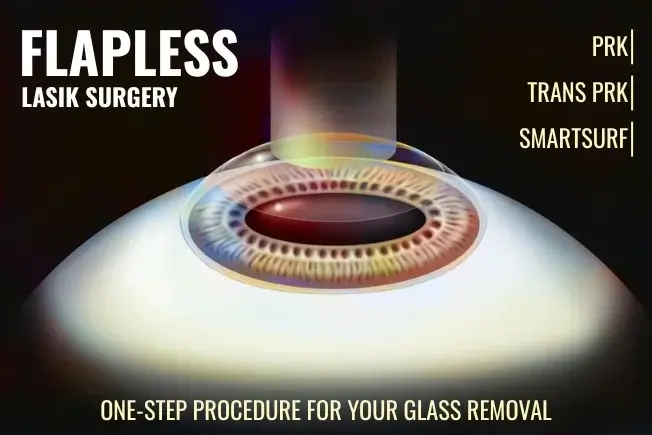
Flapless LASIK refers to laser vision correction methods that don't involve creating a corneal flap, unlike traditional LASIK. Instead of making a cut on the cornea, these procedures work directly on its surface — a difference that changes almost everything about safety, healing, and long-term eye health.
Patients want safer, simpler, and more natural recovery, and with modern no-touch technologies and gentler lasers, flapless procedures have taken the spotlight for people who want excellent vision without the added risks of a flap. Once healing is complete, the treated area typically can't even be detected on a slit-lamp examination.
Traditional LASIK vs. Flapless LASIK
Traditional LASIK creates a thin flap in the cornea, lifts it, reshapes the tissue beneath, then repositions the flap back. Flapless LASIK skips the flap step entirely and reshapes the cornea directly.
| Factor | Traditional LASIK | Flapless LASIK |
|---|---|---|
| Corneal flap | Created, lifted and repositioned | None at all |
| Flap displacement risk | Possible, even from vigorous eye rubbing | None |
| Dry eye risk | Slightly higher | Lower |
| Suitable for thin corneas | Often not suitable | Frequently suitable |
| Corneal integrity | Somewhat reduced by the flap cut | Better preserved |
| Initial visual recovery | Faster | Slightly slower |
Why the flap matters: in traditional LASIK, the flap helps access deeper corneal layers but comes with its own risks — flap dislocation, inflammation, or infection. Rubbing your eyes hard after surgery can even shift the flap. Removing that step altogether means lower overall risk, stronger corneal integrity, and a technique that's simply better suited to active lifestyles or contact sports.
1. PRK — Photorefractive Keratectomy
PRK is the original flapless laser eye surgery, and the technique from which every other flapless option evolved. It removes the thin outer layer of the cornea (the epithelium) by gently scraping it away, reshapes the eye using an excimer laser, then lets the epithelium grow back naturally.
Epithelium Removal
The outer corneal layer is removed using alcohol delamination or gentle scraping.
Laser Reshaping
An excimer laser reshapes the corneal surface to correct your refractive error.
Bandage Contact Lens
A bandage contact lens is applied to protect the eye as the epithelium regrows.
| Pros | Cons |
|---|---|
| No flap complications | Longer healing (around 7 days) |
| Suitable for thin corneas | More discomfort in the first few days |
| Long-lasting results | — |
2. TransPRK — Transepithelial PRK
TransPRK is PRK's more advanced evolution. It's a no-touch, single-step laser procedure — the laser removes the epithelium and reshapes your cornea in one continuous pass. No scraping, no tools, no manual contact with the eye at all.
Less Trauma to the Eye
No manual epithelial removal means gentler treatment overall.
More Predictable Outcomes
A single, continuous laser pass gives more consistent, reliable results.
Lower Infection Risk
Zero physical contact with the eye during the epithelial-removal step.
Expect discomfort for 2-3 days, gradual improvement in vision clarity over the following week, and visual stability within 3-4 weeks. Read our full TransPRK guide →
3. SmartSurf — The Latest Evolution
SmartSurf is the latest version of TransPRK, using Smart Pulse Technology to deliver ultra-smooth results and accelerated healing. It maps over 1,00,000 points on the cornea to remove aberrations (irregularities) for better night vision and contrast — no cuts, no instruments, just laser.
This smoother corneal surface reduces healing time, enhances visual quality, and lowers discomfort compared to standard TransPRK. Most patients see significant improvement within 4-5 days, with full recovery happening faster than traditional PRK. Read our full SmartSurf guide →
How Do PRK, TransPRK, SmartSurf and InnovEyes Compare?
| Parameter | PRK | TransPRK | SmartSurf | InnovEyes |
|---|---|---|---|---|
| Discomfort | More during recovery | Mild | Very minimal | Still evolving — varies |
| Touchless procedure | No — manual removal | Yes, fully | Yes, fully touch- & blade-free | Yes, but less proven comfort |
| Healing time | ~7 days | 4-5 days | 3-4 days | 4-6 days (limited data) |
| Long-term vision outcome | Good | Excellent | Excellent, better clarity | Expected good, not widely proven |
| Technology | Basic | Trusted & advanced | Most advanced laser tech | New launch, still gaining trust |
| Dry eye risk | Reduced | Low | Very low | Data not fully available |
| Customisation | Low | Medium | High-precision smart mapping | Claims customisation — results pending |
Common Myths About Flapless LASIK — Debunked
Myth: TransPRK and Wavelight InnovEyes are the same. Not true — TransPRK is a tested, globally trusted method, while InnovEyes is newer and still gaining clinical reliability.
Myth: SmartSurf is just marketing. Incorrect — SmartSurf combines the benefits of TransPRK with enhanced precision and comfort, making it one of the most advanced options available today.
Myth: Wavelight InnovEyes gives better results. No current evidence supports superior results compared to SmartSurf or TransPRK.
Who Is a Good Candidate for Flapless LASIK?
Adults over 18 with a stable vision prescription for at least the past year.
Healthy corneal thickness and good overall eye health, confirmed by evaluation.
Thinner-than-average corneas, where flap-based LASIK may not be ideal.
Contact-sport athletes or people with active, physically demanding lifestyles.
Dry eye patients, since flapless techniques disrupt fewer corneal nerves.
Who Should Avoid Flapless LASIK?
Unstable or Progressive Prescription
Your eye power should be stable for at least a year before considering surgery.
Very Thin or Irregular Corneas
Severe corneal thinning or keratoconus rules out laser reshaping altogether.
Uncontrolled Diabetes or Active Eye Disease
These need to be stabilised and treated before any refractive procedure.
Pregnancy or Breastfeeding
A temporary restriction, since hormonal changes can affect corneal shape.
How Should You Prepare Before Surgery?
Avoid wearing contact lenses for a few days before your evaluation and surgery, since they can temporarily change your cornea's shape and affect measurement accuracy. Maintain good eye hygiene in the days leading up to your procedure, and make sure to complete your full diagnostic workup — corneal mapping, thickness measurement, and tear film analysis — so your surgeon can confirm the right technique for your eyes.
What Is the Recovery Timeline?
Day 1
Vision may be blurry, with mild discomfort, tearing or light sensitivity as the surface begins healing.
Day 2-5
Functional vision returns for most patients; the bandage contact lens is typically removed around this point.
Week 1
Most people return to work; avoid rubbing your eyes, swimming, or eye makeup for about a week.
Week 3-4
Visual outcomes stabilise for the large majority of patients.
Avoid driving until your doctor confirms your vision has cleared enough, wear sunglasses to reduce light sensitivity, and don't skip any scheduled follow-up visit.
What Are the Risks and Side Effects?
Mild Irritation or Blurry Vision
CommonExpected in the first few days as the surface heals.
Dry Eyes
MildLower risk than flap-based LASIK, but temporary dryness can still occur, especially with PRK.
Night Glare or Halos
MildUsually settles as vision fully stabilises over the following weeks.
Corneal Haze
MildCan occur, more so with PRK-based procedures, and is generally managed with prescribed drops.
Infection
RareLow risk overall, further reduced by the touch-free nature of TransPRK and SmartSurf.
Vision Regression Needing Enhancement
RareSome patients may need a further touch-up procedure if power partially returns over time.
Cost Comparison of Flapless LASIK Types
| Procedure | Average Cost (Both Eyes) |
|---|---|
| PRK | ₹60,000 |
| TransPRK | ₹60,000 |
| SmartSurf | ₹90,000 |
| Wavelight InnovEyes | ₹1,50,000 and above |
SmartSurf and TransPRK stand out as the most reliable, comfortable options — offering excellent vision results, faster recovery, and long-term safety backed by clinical results. InnovEyes is promising but still newer and less proven in real-world patient outcomes. Most insurance plans don't cover elective vision correction, but No-Cost EMI is available at Save Sight Centre.
Choosing the Right Procedure for You
Age
Older eyes may need a little more time to recover fully.
Lifestyle
Play contact sports or lead an active life? Flapless is usually the safer route.
Corneal Thickness
Thin corneas often rule out flap-based LASIK, but not flapless options.
Doctor's Recommendation
Always consult a qualified refractive surgeon who will map your cornea and suggest what genuinely fits you.
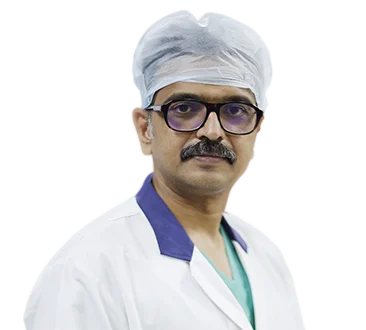
Dr. Rajeev JainDirector · Retina, Cataract, LASIK & Uvea Specialist
"Patients often come in asking specifically for 'the newest laser,' but the right flapless option depends entirely on their own cornea — its thickness, shape, and how their eyes have responded to any prior procedures. PRK, TransPRK and SmartSurf all remove the same risk of a flap, but they aren't interchangeable in comfort or recovery speed. That's exactly why a proper corneal mapping evaluation comes before any recommendation, not after."
Frequently Asked Questions About Flapless LASIK
PRK removes the outer layer of the cornea without creating a flap, making it ideal for thin corneas. LASIK creates a flap for quicker recovery but isn't suitable for everyone.
Most patients report only mild discomfort during the first few days. Numbing drops and bandage contact lenses help minimize pain.
Initial healing typically takes 3-5 days. Visual clarity improves over a few weeks, with full results in about a month.
Yes, TransPRK is often safer for people with active lifestyles or thin corneas because there's no flap to dislodge or injure.
Absolutely. TransPRK is often preferred for dry eye patients as it causes less nerve disruption than LASIK.
Yes, vision correction from SmartSurf and other flapless techniques is long-lasting, similar to LASIK.
People with thin corneas, irregular corneal surfaces, or a risk of eye trauma may be better candidates for flapless options.
The cost varies by hospital and location. Some flapless options may be slightly more expensive due to advanced technology, but they offer long-term value. At Save Sight Centre, flapless surgery starts at just ₹60,000.
Yes, but you should avoid strenuous activity for about a week. Since there's no flap, the risk of dislodging it is eliminated.
SmartSurf is considered one of the most advanced, offering precise results with minimal discomfort and no flap-related complications.
No, flapless LASIK is not performed at the same time as cataract surgery. Each procedure targets a different eye condition and needs its own separate planning, evaluation and recovery timeline.
Some regression is possible over time, especially with higher original prescriptions. If needed, an enhancement procedure can often correct any remaining or returning power, following a fresh evaluation to confirm your cornea is suitable.
SMILE doesn't create a traditional LASIK flap either, so it's sometimes grouped under the flapless umbrella. However, it works differently from PRK, TransPRK and SmartSurf — using a femtosecond laser to remove a lenticule through a small incision rather than reshaping the surface directly.
Not Sure Which Flapless Option Suits Your Eyes?
Get a detailed corneal evaluation at Save Sight Centre, Adarsh Nagar, North Delhi. NABH & ISO accredited · 25+ years · 1,70,000+ patients treated.
Disclaimer: For general awareness only, not medical advice. Please consult an eye specialist at Save Sight Centre to determine the best procedure for your eyes. Results vary by person. Figures cited are approximate and based on general clinical patterns and published research.