

 +91-7873-222-000
 WhatsApp

 Book Appointment
Femto (Bladeless) LASIK Surgery: Benefits, Cost & Recovery
For many people, the word "blade" is the single biggest thing standing between them and laser eye surgery. Femto LASIK removes that concern entirely — a femtosecond laser creates the corneal flap instead of a mechanical blade, offering more precise, consistent results. Here's exactly how it works, how it genuinely compares to traditional LASIK, and what to expect.
Quick Answer
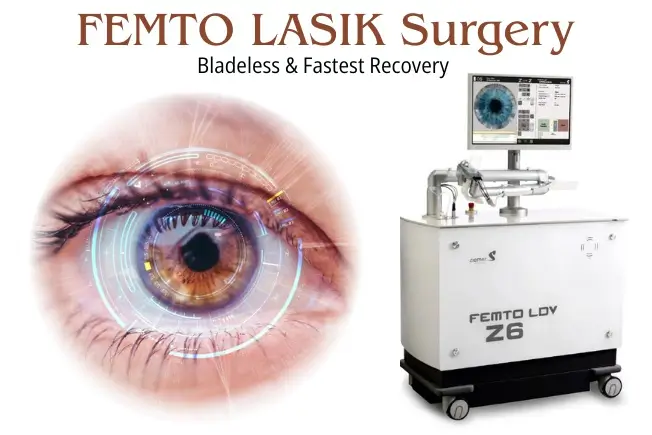
Femto LASIK is a laser eye surgery where a femtosecond laser — not a mechanical blade — creates the thin corneal flap, which is then lifted so an excimer laser can reshape the cornea underneath to correct myopia, hyperopia, or astigmatism. The main advantage over traditional blade LASIK is a more uniform, precisely controlled flap, which meaningfully lowers the risk of mechanical flap complications like buttonholes or free caps. It doesn't automatically produce sharper final vision than blade LASIK — research shows no strong consensus on that point — but it is the preferred choice for many patients, particularly those with borderline corneal thickness or an unusually shaped cornea.
Key Takeaways
- Femto LASIK uses a femtosecond laser instead of a blade to create the corneal flap — the rest of the procedure (excimer laser reshaping) is identical to traditional LASIK.
- It significantly reduces mechanical flap complications like buttonholes, free caps, and irregular flaps, which are rare but possible with a blade.
- Blade LASIK still has advantages: shorter suction time, more comfort for some patients, and a long, well-established safety record.
- Research doesn't show a clear consensus that femto produces better final vision than blade LASIK — its real edge is flap precision and safety, not sharper eyesight.
- The whole procedure takes 15-20 minutes per eye; most patients see clearly within 24-48 hours.
- Very thin or unusually shaped corneas may still need a flapless alternative (PRK/TransPRK) or ICL instead of any form of LASIK.
Figures reflect general clinical patterns and can vary based on individual eye health and healing.
What Is Femto (Bladeless) LASIK?
Femto LASIK is a type of laser eye surgery where a femtosecond laser is used to create a thin flap in the cornea instead of a microblade — which is exactly why it's called bladeless LASIK. It's a highly precise, customised technology used to treat refractive errors including myopia (nearsightedness), hyperopia (farsightedness), and astigmatism.
How Does Femto LASIK Actually Differ From Blade LASIK?
Both approaches use exactly the same second step — an excimer laser reshapes the cornea to correct your prescription. The real difference is entirely in how the initial flap is created:
Blade LASIK uses a microkeratome, a precision mechanical blade, to cut the flap. It's faster to perform and involves a shorter suction time, which some patients find more comfortable. However, blade quality and corneal curvature can occasionally lead to flap complications — buttonholes (improperly formed flaps), free caps (fully detached flaps), or irregular/partial flaps.
Femto LASIK uses a femtosecond laser to create the flap with a pre-programmed, consistent thickness regardless of the cornea's curve. This meaningfully reduces the risk of the mechanical flap problems seen with a blade. The trade-off is a slightly longer suction time during flap creation, and a small chance of transient light sensitivity for a few days afterward.
Worth knowing: Research on final visual outcomes shows no strong consensus that femto produces sharper vision than blade LASIK in experienced hands — some studies favour femto, others find no meaningful difference. Femto's genuine advantage is a more predictable, uniform flap and lower mechanical complication risk, not guaranteed better eyesight.
Femto LASIK vs Traditional (Blade) LASIK
| Feature | Femto LASIK | Blade LASIK |
|---|---|---|
| Flap creation tool | Femtosecond laser | Microkeratome (blade) |
| Flap thickness consistency | Highly uniform, pre-programmed | Good, but more variable |
| Mechanical flap complication risk | Lower | Slightly higher (rare) |
| Suction time | Longer (20-30 sec) | Shorter (5-10 sec), more comfortable |
| Transient light sensitivity | Possible for a few days | Less common |
| Final visual quality | No clear consensus vs blade | No clear consensus vs femto |
| Cost | Generally higher | Generally lower |
What Are the Step-by-Step Stages of Femto LASIK?
The procedure reshapes the cornea to improve how light enters the eye. Total duration is 15-20 minutes per eye, and no stitches are required.
Creating the corneal flap
A femtosecond laser creates a thin, precise flap in the outer layer of the cornea.
Lifting the flap
The surgeon gently lifts the flap to access the corneal tissue underneath.
Reshaping the cornea
An excimer laser reshapes the exposed corneal tissue based on your specific prescription.
Repositioning the flap
The flap is placed back naturally, where it adheres without stitches as it heals.
Who Is Eligible for Femto LASIK?
Not everyone is suitable for Femto LASIK.
You may be eligible if:
- You are above 18 years of age
- Your vision has been stable for at least 6 months
- You have a healthy cornea of adequate thickness
- You have no major eye disease
You may need to avoid it, or consider alternatives, if:
- You are pregnant or breastfeeding (hormonal changes can affect vision stability)
- You have significant dry eyes that isn't well controlled
- You have corneal thinning — see our dedicated guide to refractive surgery for thin corneas for alternative options like PRK/TransPRK or ICL
Is Femto LASIK the Same as SMILE Surgery?
No, though both use femtosecond laser technology. In Femto LASIK, the laser creates a flap that's lifted so a second, excimer laser can reshape the cornea underneath. In SMILE (Small Incision Lenticule Extraction), the femtosecond laser alone removes a small, lens-shaped piece of tissue through a much smaller incision, without lifting a full flap at all. SMILE offers a smaller incision and some theoretical corneal-strength advantages, but Femto LASIK has decades more outcome data and a broader treatment range for different prescriptions. Your surgeon can advise which suits your specific eyes.
What Are the Benefits of Femto LASIK?
Blade-Free Precision
Eliminates the mechanical flap risks associated with a blade.
High Accuracy
Laser-guided flap creation ensures consistent, pre-programmed precision.
Faster Recovery
Most patients recover functional vision within 24-48 hours.
Minimal Discomfort
The procedure itself is virtually painless under numbing drops.
Reduced Mechanical Complications
Lower risk of flap-related issues compared with a blade-based approach.
Long-Lasting Results
Correction is permanent in most cases, aside from natural age-related changes like presbyopia later in life.
What Does Recovery After Femto LASIK Look Like?
Recovery is generally quick and smooth.
What to expect:
- Mild irritation for a few hours after surgery
- Noticeably clearer vision within 1-2 days
- Full stabilisation over 1-2 weeks
Tips for a smoother recovery: avoid rubbing your eyes, use prescribed drops exactly as directed, wear protective eyewear as advised, and avoid dust and water exposure in the eye area during the initial healing period.
What Are the Risks and Side Effects?
Femto LASIK is a well-established, safe procedure, but like any surgery, minor temporary side effects can occur, and are generally manageable with drops and medication as directed by your surgeon:
- Dry eyes — usually temporary, managed with lubricating drops
- Glare or halos — particularly at night, often easing over the following weeks
- Light sensitivity — a specific, usually transient effect linked to femtosecond flap creation
- Rare inflammation (diffuse lamellar keratitis) — uncommon, and treatable with prompt medical attention if it occurs
Serious complications are genuinely rare when the procedure is performed by experienced surgeons like Dr. Rajeev Jain and Dr. Shuchi Gupta.
What Does Femto LASIK Cost in Delhi?
The cost of Femto LASIK at Save Sight Centre is ₹75,000 for both eyes, among the most competitive procedure-only pricing in Delhi. This includes:
- Free LASIK pre- and post-operative workup (worth ₹4,000)
- Advanced femtosecond laser technology
- 25+ years of combined surgeon expertise
- Convenient hospital access in North Delhi
- 15+ years of clinical excellence
Pricing may vary based on individual eligibility assessment and any additional pre-operative findings — confirm final cost during your consultation.
What Eye Care Tips Help After Femto LASIK?
Immediately after surgery (first 24-48 hours): Keep your eyes closed and rest as much as possible; do not rub or touch your eyes; use prescribed antibiotic and lubricating drops exactly as directed; wear protective eye shields while sleeping; avoid bright lights, screens, and prolonged reading.
Hygiene: Wash your hands before applying eye drops; avoid getting water, soap, or shampoo in your eyes for at least a week; skip eye makeup for 7-10 days; avoid dusty or polluted environments.
Activities to avoid: No swimming, hot tubs, or saunas for 2-3 weeks; avoid heavy workouts or the gym for a week; no contact sports for 3-4 weeks; limit screen time initially to reduce dryness.
Follow-up: Attend all scheduled appointments (typically next day, 1 week, and 1 month); contact your doctor immediately if you notice severe pain, sudden vision loss, or unusual redness or discharge. Staying hydrated, eating a diet rich in vitamins A and C, following the 20-20-20 rule, and getting good sleep all support faster healing.
Dr. Rajeev JainDirector · Retina, Cataract, LASIK & Uvea Specialist
"Patients often assume 'bladeless' automatically means 'better vision,' and I like to correct that gently before surgery. What femto genuinely gives you is a more predictable, safer flap — not a guarantee of sharper eyesight than blade LASIK. Both are excellent options in experienced hands; the right choice depends on your specific cornea, not a marketing label."
Frequently Asked Questions About Femto LASIK
No, it is painless due to numbing drops used throughout the procedure. Most patients feel only mild pressure during flap creation.
Around 15-20 minutes per eye, including both the flap creation and corneal reshaping steps.
Yes, in most cases. Femto LASIK permanently reshapes the cornea, so results are generally long-lasting, though natural age-related vision changes like presbyopia can still occur later in life.
Rarely, but minor changes may occur, particularly in the first year as the eye stabilises. Some patients may need a small touch-up (enhancement) procedure if their prescription shifts slightly.
Usually after 24-48 hours, once initial light sensitivity and dryness have settled, though it's still worth taking regular screen breaks in the following days.
Yes, it is one of the safest and most widely performed refractive procedures available, with a well-established track record when performed by an experienced surgeon.
Femtosecond lasers create a flap of consistent, pre-programmed thickness regardless of the cornea's curve, which significantly lowers the risk of mechanical flap problems sometimes seen with a blade — including buttonholes (improperly formed flaps), free caps (fully detached flaps), and irregular or partial flaps. These blade-related complications are uncommon overall, but femto technology reduces them further.
Femto LASIK is generally priced higher than blade LASIK, reflecting the cost of the femtosecond laser technology. It isn't automatically "better" in every respect — blade LASIK has a shorter suction time (making it slightly more comfortable for some patients) and a long safety record, while femto's main advantage is a more uniform, precisely controlled flap. Research shows no strong consensus that femto produces sharper final vision than blade LASIK in experienced hands — its real edge is in reducing flap-related risk.
It can be, since the femtosecond laser allows more precise, shallower, and more predictable flap thickness regardless of corneal curvature. That said, a very thin cornea may still rule out LASIK altogether in favour of flapless options like PRK/TransPRK or ICL — read our dedicated guide to refractive surgery for thin corneas for more detail.
Femto LASIK uses a femtosecond laser to create a flap, which is then lifted for an excimer laser to reshape the cornea underneath. SMILE (Small Incision Lenticule Extraction) uses only the femtosecond laser to remove a small lens-shaped piece of tissue through a much smaller incision, without lifting a full flap. SMILE offers a smaller incision, but Femto LASIK offers broader treatment range and decades of outcome data — your surgeon can advise which suits your specific eyes and prescription.
Considering Femto LASIK for Glasses-Free Vision?
Get a thorough eligibility assessment at Save Sight Centre, Adarsh Nagar, North Delhi. NABH & ISO accredited · 15+ years · 1,70,000+ patients treated.
Disclaimer: The information on this site should not be considered as medical advice. Please consult a doctor for determining the best procedure as well as the most appropriate lens for your eyes. The results may vary from person to person and we do not guarantee similar results for everyone.