
 +91-7873-222-000
 WhatsApp

 Book Appointment
Customized LASIK Surgery: Made Specifically for Your Eyes
Customized LASIK is an advanced, flap-based laser eye surgery designed around your unique corneal shape, eye power, and visual needs — not just your spectacle number. Detailed eye mapping helps deliver sharper, more personalised vision correction than standard LASIK.
Quick Answer
Customized LASIK is an advanced laser eye surgery that corrects your vision based on the unique shape of your own cornea — not just your spectacle prescription. Standard LASIK treats mainly your power number; Customized LASIK uses detailed corneal topography, curvature and thickness measurements to also smooth out the tiny surface irregularities every cornea has, which can otherwise cause halos, glare, or vision that never feels quite sharp enough. The result is typically sharper visual quality and better night vision, especially for driving and screen use, with recovery and safety similar to standard LASIK.
Key Takeaways
- Customized LASIK maps your cornea's exact shape, curvature and thickness — not just your glasses prescription — to plan the laser treatment.
- It's especially aimed at improving night vision, glare and halos, alongside standard specs removal.
- A precision microkeratome creates a thin, 130-micron flap; the whole laser treatment takes well under 2 minutes per eye.
- Most patients see a major improvement within 24 hours, with full visual stabilisation by 3-4 weeks.
- Not everyone is a candidate — an unstable prescription, keratoconus, thin corneas, or certain autoimmune conditions can rule it out.
- Costs ₹35,000 for both eyes at Save Sight Centre, including a free LASIK workup.
What Is Customized LASIK Surgery?
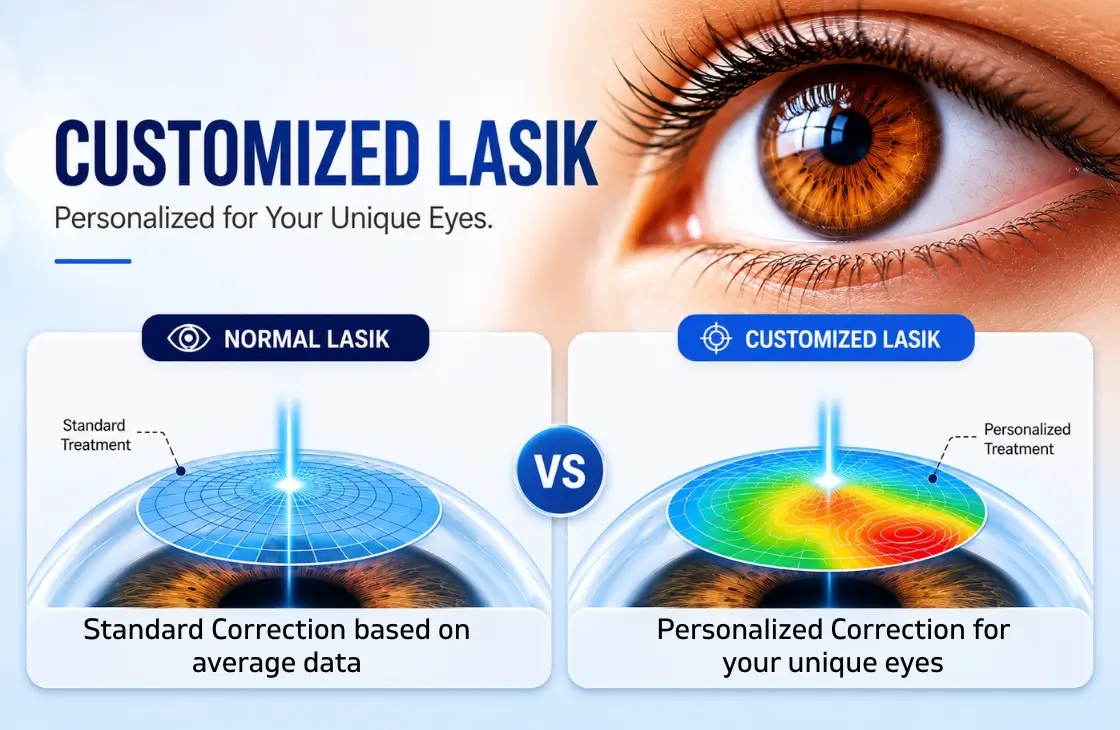
Customized LASIK is an advanced laser eye surgery that treats your vision according to the unique imperfections of your own eyes. In standard LASIK, patients typically receive a treatment based mainly on their spectacle power. In Customized LASIK, advanced eye scanning creates a detailed map of your eyes, helping the laser deliver a highly personalised correction for genuinely better visual quality.
Every cornea has a slightly different shape — small bumps, dips and curves that a basic prescription simply can't capture. These irregularities are what cause issues like halos around lights at night, blurry vision in dim conditions, or a nagging feeling that your vision is never quite sharp enough, even with glasses. Customized LASIK measures these surface variations and programs the laser to smooth and correct them as part of your treatment.
What We Measure Before Surgery and Why It Matters
Before a single drop touches your eye, your surgeon collects a set of measurements that are what actually make your treatment "customized":
Corneal topography: A detailed, high-resolution map of your cornea's surface, capturing the tiny hills and valleys unique to your eye — so the laser corrects your cornea's actual shape, not just a prescription number.
K-readings (corneal curvature): Measures how steep or flat your cornea is, telling the surgeon your cornea's current power and how to calculate the exact correction for your astigmatism.
Pachymetry (corneal thickness): The key safety check — measured in microns, this confirms enough corneal tissue (a safe minimum of 250 microns) will remain beneath the treated area after the flap and laser ablation.
Pupil size (mesopic): Measured in a dim room to capture your pupil at its largest, ensuring the laser treatment area fully covers your pupil in low light — protecting your night vision from halos.
Refraction: Your exact eye power — sphere, cylinder and axis — measured both normally and after relaxing drops, then cross-referenced with your topography to finalise your correction target.
Before your workup: Remove soft contact lenses at least 5-7 days before your appointment; if you wear hard (RGP) lenses, remove them 2-4 weeks before. Contact lenses temporarily change your cornea's shape — topography must be taken once your cornea has returned to its natural shape, or your entire custom plan will be inaccurate.
How Does Customized LASIK Surgery Work?
Numbing Eye Drops
Anaesthetic drops are placed in your eye — no injections, no pain. A small speculum gently holds your eyelids open.
130-Micron Flap Created
A precision microkeratome creates a thin, hinged flap on your cornea. You may feel brief pressure for a few seconds. The flap is gently folded back.
Custom Laser Fires
The excimer laser delivers your personalised ablation — correcting your prescription and smoothing your cornea's unique irregularities at the same time.
Flap Repositioned
The flap is carefully placed back and adheres naturally within minutes — no stitches. The surgeon checks the flap alignment before you leave.
You'll be at the clinic for about 2-3 hours in total, including preparation and post-procedure rest — but the actual laser treatment per eye takes well under 2 minutes. All patients go home the same day, with dramatically improved vision typically noticeable by the next morning.
What Is the Recovery Timeline After Customized LASIK?
First 4-6 Hours
Rest at home with mild discomfort and watery eyes. Vision will be blurry — avoid screens and bright light, use prescribed drops, and sleep if possible as the eye heals rapidly during this window.
Day 1 (Next Morning)
Most patients see clearly enough to function. The first post-op check confirms the flap is correctly positioned; reading and screen use are usually comfortable, and driving may be possible once your doctor clears you.
Week 1
Return to desk work and daily activities. Avoid swimming, dusty environments and eye makeup. Some day-to-day fluctuation in vision is completely normal this week.
Week 2-3
Night vision improves as the cornea settles. Any remaining halos or glare from healing diminish during this period. Light exercise is fine; contact sports are still avoided.
After Week 4
Final vision is fully stable. The complete benefit of the custom ablation becomes visible, and most patients reach their best-ever vision quality. Your final prescription is confirmed at the one-month check.
What Should You Avoid After Customized LASIK?
Swimming & Hot Tubs
Avoid these for at least 2-4 weeks after surgery to reduce infection risk.
Contact Sports
Avoid for at least 4 weeks; protective eyewear is recommended once you resume.
Eye Makeup
Wait at least 3-4 weeks before applying any eye makeup.
Rubbing Your Eyes
Never rub — the 130-micron flap can be displaced. This is critical for the first month.
Customized LASIK vs. Standard LASIK
| Basis of Comparison | Customized LASIK | Standard LASIK |
|---|---|---|
| Flap thickness | 130 microns | Usually thicker |
| Treatment pattern | Personalised to your cornea | Standard, based mainly on power |
| Visual quality | Sharper & more detailed | Standard clarity |
| Night driving vision | Better | Average |
| Best for | Premium visual quality | Basic vision correction |
Why Choose Customized LASIK?
Customized LASIK isn't only about removing glasses — it focuses on improving the quality of vision for daily life, screen use, night driving, and overall visual comfort.
Sharper Vision
Corrects visual imperfections that regular LASIK may miss entirely.
Better for a Digital Lifestyle
Especially helpful for professionals, students, and anyone spending long hours on screens.
Improved Driving Vision
Better contrast sensitivity and a noticeably clearer night driving experience.
Advanced Safety
Modern laser technology increases treatment precision and overall accuracy.
Who Is a Good Candidate for Customized LASIK?
Candidacy is determined by your workup measurements — particularly corneal thickness, prescription, and topography.
18 years or older, with a stable prescription for at least 6 months.
Nearsighted (myopia), farsighted (hyperopia), or have astigmatism.
Corneas thick enough to safely allow a 130-micron flap plus the planned laser ablation.
Generally in good health, with no active autoimmune conditions.
Prescription Still Changing
Year-to-year changes mean it's better to wait until your power stabilises.
Pregnancy or Breastfeeding
Hormonal changes affect corneal shape, making measurements unreliable.
Keratoconus or Corneal Disease
Advanced or progressive corneal conditions rule out flap-based LASIK.
Certain Autoimmune Conditions
Including lupus or rheumatoid arthritis, which can affect healing.
Extremely Thin Corneas
Beyond the safe limit for a flap-based procedure like this one.
Severe Untreated Glaucoma or Cataract
These need to be addressed first, or may call for a different procedure altogether.
A LASIK workup is the most reliable way to know what suits your eyes — our specialists use corneal topography, fundus examination, refraction tests and more to confirm your eligibility.
What Are the Risks and Side Effects?
Temporary Dry Eye
CommonLess common with this flap-based technique than with older approaches — usually resolves within 3-6 months with prescribed lubricating drops.
Night Glare or Halos
CommonSome patients notice halos around lights at night initially — usually temporary as the cornea settles.
Flap Complications
RareButtonhole or incomplete flaps are very rare with this precision technique.
Corneal Ectasia
Very RareA risk with all LASIK types, significantly reduced here since more of the corneal bed is preserved.
Infection
Very RareExtremely low risk in accredited surgical centres; antibiotic drops are prescribed both before and after surgery to help prevent it.
How Much Does Customized LASIK Cost?
The cost of Customized LASIK depends on the technology used, surgeon experience, pre-operative evaluation, and hospital infrastructure. Since this procedure uses advanced, personalised eye-mapping technology, it usually costs more than standard LASIK.
At Save Sight Centre, Delhi, Customized LASIK costs ₹35,000 for both eyes. We're an NABH and ISO accredited eye hospital offering a cost-effective, reasonable investment for patients seeking freedom from glasses with high-quality technology and experienced eye surgeons like Dr. Rajeev Jain and Dr. Shuchi Gupta.
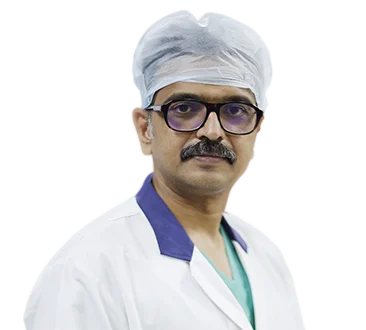
Dr. Rajeev JainDirector · Retina, Cataract, LASIK & Uvea Specialist
"What makes Customized LASIK different is that we're not treating a number on a prescription slip — we're treating the actual shape of your cornea, bumps and all. That's exactly why the workup matters as much as the surgery itself: get the corneal mapping, pachymetry and pupil measurements right, and patients consistently tell us their night driving and screen comfort improved just as much as their basic eyesight."
Frequently Asked Questions About Customized LASIK
Most patients notice a major improvement in vision within 24 hours and return to desk work and daily activities within 2-3 days. Full visual stabilisation, where the prescription is completely settled, typically happens within 3-4 weeks. Night vision often continues to improve during the first 4-6 weeks as the cornea heals and any mild halos from the healing process fade.
Customized LASIK aims to give you vision at least as good as your best-corrected vision with glasses, and many patients feel it's even sharper thanks to the smoothing of corneal irregularities. It corrects your current eye power to zero, but it cannot prevent your prescription from changing again in the future for unrelated reasons, such as age-related presbyopia.
No. Numbing eye drops are used during surgery, so patients usually feel only mild pressure for a few seconds. After the surgery, some mild discomfort for a few hours is common, but this typically feels much better by the next day.
Yes. It is considered a safe, advanced procedure when performed after a proper evaluation by an experienced eye surgeon. Nothing enters the eye — the laser simply reshapes the outermost layer, the cornea — making it one of the safest surgeries performed on any part of the body.
Yes. Customized LASIK is specifically designed to improve visual quality and reduce night glare and halos by accounting for your pupil size and corneal irregularities, alongside removing your need for glasses.
At Save Sight Centre, Customized LASIK is planned using detailed corneal topography, K-readings, pachymetry, pupil size and refraction data — not wavefront or aberrometry-based mapping used by some other branded procedures. Both approaches aim for a more personalised correction than standard LASIK; ask your surgeon which technology is used for any procedure you're considering, since naming can vary between clinics.
The correction to your current refractive error is intended to be permanent, since the cornea's reshaping doesn't reverse over time. However, LASIK cannot prevent unrelated future changes, such as presbyopia after 40 or cataracts later in life, both of which are managed separately if they occur.
Ready to See With Your Own Eyes?
Book your free comprehensive eye evaluation at Save Sight Centre, Adarsh Nagar, North Delhi. NABH & ISO accredited · 25+ years · 1,70,000+ patients treated.
Disclaimer: For general awareness only, not medical advice. Please consult an eye specialist at Save Sight Centre to determine the best procedure for your eyes. Results vary by person. Figures cited are approximate and based on general clinical patterns and published research.